


CHANEL Paris-Salzburg · Métiers d’Art 2014/15
Sisi’s Austriasurrenders toLagerfeld
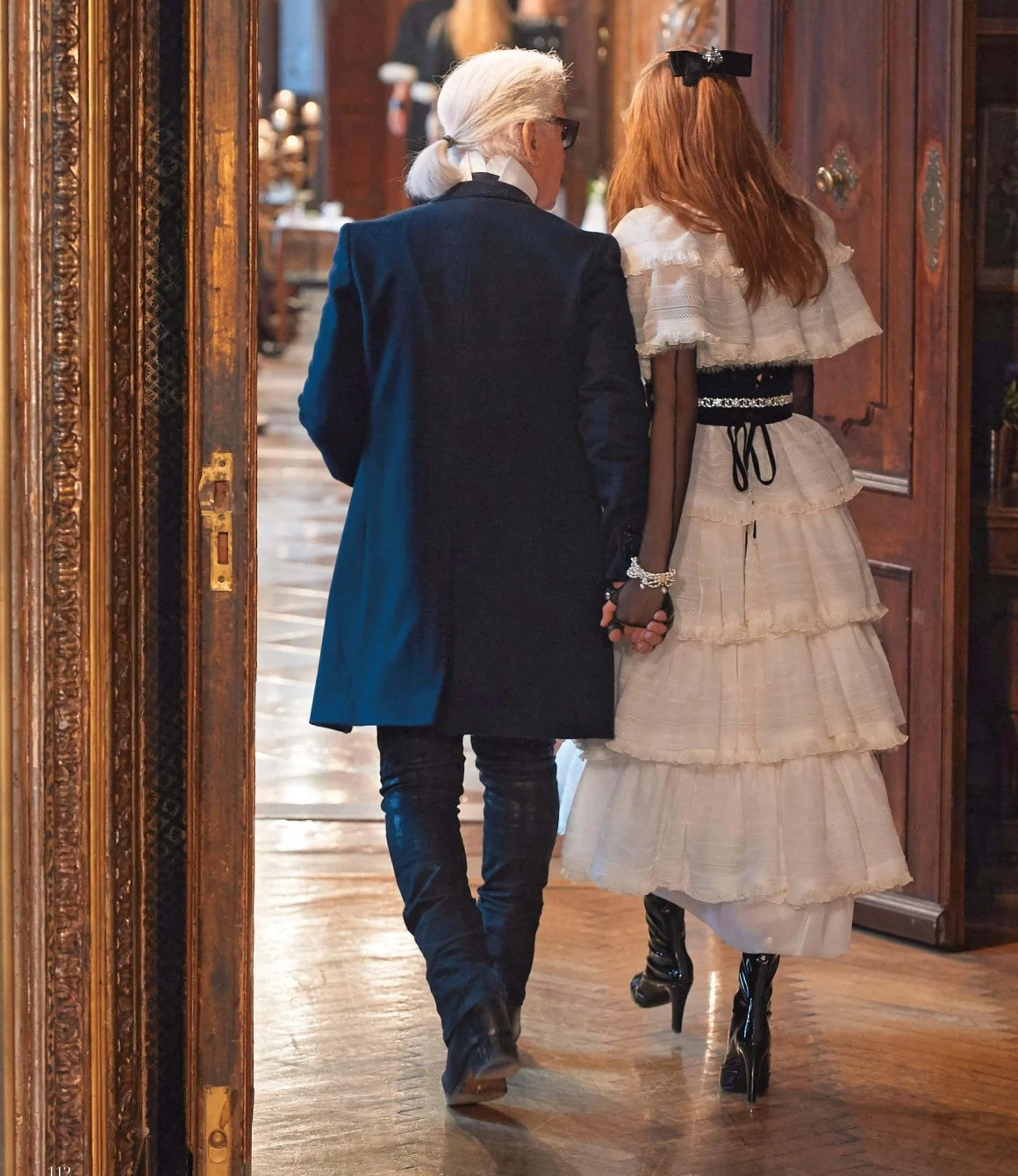
What would Mozart have made of Chanel? Karl Lagerfeld had rather more pressing business in Salzburg: an appointment with Empress Elisabeth, a rendezvous with Gabrielle Chanel’s legendary lift boy, and a childhood obsession with Tyrolean clothes to revisit. All three converged on 2 December 2014 at Schloss Leopoldskron, a rococo palace where Lagerfeld staged his Paris-Salzburg Métiers d’Art collection.

I
Schloss Leopoldskron: The Indiscreet Charm of Aristocracy
Leopoldskron at dusk, the night of the show, 2 December 2014
“First, it is the town of Mozart, and it is a musical town,” said Hubert Barrère, artistic director of Lesage, explaining the choice of Salzburg. Lagerfeld’s enthusiasm for Schloss Leopoldskron, however, owed less to Mozart than to Max Reinhardt, a man whose taste for theatrical extravagance was perfectly compatible with his own.
Built in 1736 for Prince-Archbishop Leopold Anton von Firmian, the palace acquired an altogether different cultural identity when Reinhardt bought it in 1918. Together with Richard Strauss and Hugo von Hofmannsthal, he founded the Salzburg Festival two years later, establishing an intellectual society in surroundings that Hollywood would eventually make synonymous with the von Trapp family in The Sound of Music.
Reinhardt had approached the decoration of Leopoldskron with the imagination of a man accustomed to inventing entire worlds for a living. His Venetian Room incorporated gilded panels depicting characters from the Italian Commedia dell’arte, while his library, modelled on the magnificent Abbey Library of St. Gallen, accommodated some fifteen thousand volumes and, with a lovely theatrical touch, a concealed staircase. The palace even had a room in which the Salzburg Festival was conceived. Evidently, at Leopoldskron, an interesting conversation could have consequences lasting well beyond dinner.


“For me, the Schloss belongs to the history of the German-language theater and culture between 1920 and 1938,” Lagerfeld explained. He had photographed there twenty-six years earlier and spoke of its cultural history with an affection that was unusually personal: “These things are very dear to my heart.”
Chanel took possession of the first floor for two weeks. Additional period furniture arrived, floors were polished, rooms repainted, and the distinction between preparing a fashion show and restoring an eighteenth-century palace became pleasantly blurred.
For the Métiers d’Art 2015 collection, also known as Chanel Pre-Fall 2015, the Venetian Room, the White Room, the Marble Hall, the Chinese Room and Reinhardt’s library became successive episodes in a fashion spectacle. Lara Stone opened the show, Cara Delevingne and Kendall Jenner circulated through the rococo interiors, and waiters appeared with plum waffles. The marriage of intellectual culture and confectionery was impeccably Austrian.
Reinhardt would surely have appreciated the arrangement. His guests had once moved from room to room through an evening of conversation and performance; Lagerfeld had simply introduced a new cast, a wholly new wardrobe and the peculiar theatrical convention of the fashion front row.

The route of the show through the state rooms


II
Tyrolean Fantasy: The Importance of Being Austrian

Austria had fascinated Lagerfeld long before Chanel entered his life. As a little boy, he insisted on wearing the traditional Tracht his parents bought him in Salzburg. “I did not want to look like the other boys,” he recalled, providing in ten words a remarkably comprehensive explanation of his subsequent career.
Traditional Austrian dress was hardly the obvious sartorial choice for a boy growing up in Hamburg, which was presumably part of its attraction. Even at that age, Lagerfeld appears to have understood the usefulness of clothes in acquiring an identity more interesting than the one assigned by geography.
On the eve of the Salzburg show, he appeared at dinner in a Tyrolean jacket of his own design, grey with loden-green lapels and deer-antler buttons. For a man whose black wardrobe had become almost as recognisable as the interlocking Cs, the departure was telling. Paris-Salzburg was evidently a fantasy in which its author intended to participate.
Decades after his first encounter with Austrian Trachten, with the extraordinary resources of Lesage, Lemarié and Desrues at his disposal, he could afford to indulge that childhood passion on a different scale.
Tyrolean jackets acquired the texture of Chanel tweed and cashmere, lederhosen found an unexpectedly glamorous accomplice in over-the-knee boots, and the dirndl discovered the evening possibilities of black taffeta. Even Heidi’s celebrated braids underwent a metamorphosis into elaborate woollen earmuffs.
The Austrian wardrobe had also developed some decidedly modern habits. A black leather biker jacket could coexist with the ribbons and lace of nineteenth-century court dress, while denim accommodated the decorative stitching traditionally associated with lederhosen. Lagerfeld’s Austrians were evidently under no obligation to remain in their own century.


You can take inspiration from the apron, from the sleeves, from all the little details, but you have to forget it all and we do it in a new way.
Karl Lagerfeld in Salzburg · Lucire, December 2014
“I do not want to do anything folklore. This is more of a fantasy,” he insisted.
How else to explain the presence of a cuckoo clock, reincarnated as enamel earrings, in the jewellery cabinet of Chanel, or the elevation of the Austrian beer hall pretzel into a brooch sparkling with strass? The distinction between a tourist souvenir and an object of haute luxe had become deliciously arbitrary. One depended, it seemed, on the calibre of the jeweller.


III
The Chanel Jacket: A Lift Boy’s Social Ambitions
Schloss Mittersill in winter, the castle hotel of the legend
The most consequential wardrobe at Schloss Mittersill may not have belonged to any of its illustrious guests.
According to Chanel mythology, Gabrielle discovered the prototype of her celebrated jacket in the uniform of an Austrian hotel lift attendant. The story is generally associated with the castle and its proprietor, Baron Hubert von Pantz, who was among Mademoiselle’s lovers. As so often with Chanel, it is difficult to establish precisely where the history of fashion ends and the history of her romances begins.
The chronology is equally elusive. Her liaison with the baron belongs to the 1930s, while Lagerfeld chose 1954, the year of Chanel’s return to couture, for his cinematic interpretation of the encounter.
It was not the first time that Gabrielle had discovered considerable aesthetic potential in a man’s wardrobe. Her fascination with British country clothes, jersey and masculine tailoring had already demonstrated an instinct for recognising elegance in places where the fashion establishment was unlikely to look. A hotel lift attendant was perhaps simply the next gentleman to make an unsuspecting contribution to the history of women’s emancipation.

In the Fifties, she came back here, that’s how she saw this jacket and that’s in fact how the Chanel jacket was born.
Karl Lagerfeld, the day before the show · WWD, December 2014
What makes the anecdote irresistible is its reversal of the social hierarchy. At a hotel frequented by European aristocracy, Gabrielle apparently found her sartorial inspiration among the staff. The little braid-trimmed jacket possessed an elegance that had escaped everyone else precisely because nobody had thought to look for it there.
The Austrian jacket also offered something that was fundamental to Mademoiselle’s understanding of modernity. Its decorative braid followed the structure of the garment, its pockets had an evident purpose, and its proportions allowed the body to move without requiring the elaborate architecture of the fashionable female silhouette.
Lagerfeld’s Paris-Salzburg interpretation was particularly revealing in this respect. After decades of evolution, the four-pocket tweed jacket could still recognise something of itself in traditional Tyrolean dress, despite having acquired a vastly more sophisticated vocabulary of embroidery, ornamental hardware and construction.
By the time the Chanel jacket returned to Austria, it had accomplished one of fashion’s more spectacular feats of social mobility. It is entirely in keeping with the genius of Gabrielle Chanel that the most Parisian garment in the history of fashion may have begun its career in an Austrian lift.


The four-pocket jacket comes home: Leopoldskron, 2 December 2014
IV
Sisi and Coco: The Impertinence of a Camellia

It was Hubert Barrère of Maison Lesage who saw the intriguing affinity between Sisi and Coco. Both women had a formidable sense of independence and an inconvenient relationship with the conventions of their time. Elisabeth had married into an empire whose rules she spent much of her life trying to escape; Gabrielle built one in which she made the rules herself.
The Sisi of popular imagination owes much to Romy Schneider and the romantic trilogy of the 1950s. The historical Elisabeth was a more complicated and considerably less accommodating proposition. An accomplished horsewoman with a passion for travel and the poetry of Heinrich Heine, she was happiest when the obligations of court life were at a comfortable geographical distance. Her love of the sea even prompted her to have an anchor tattooed on her shoulder, an embellishment unlikely to have featured prominently in the official dress code of the Hofburg.
One can imagine why such a woman might have appealed to Mademoiselle.
For all their differences, both understood the power of personal iconography. Sisi had her constellation of twenty-seven diamond and pearl stars, commissioned from the Viennese court jewellers Köchert and immortalised in Franz Xaver Winterhalter’s celebrated portrait of 1865. Coco had her camellia.
There is a curious distinction between their respective emblems. Elisabeth’s stars belonged to the vocabulary of celestial magnificence traditionally associated with sovereignty. Gabrielle’s flower possessed no hereditary authority whatsoever. Its prestige was entirely of her own invention.
Lagerfeld resolved the question of precedence with characteristic audacity.
In his film Reincarnation, Elisabeth was permitted to retain her emperor, but her diamond stars had been replaced by white camellias.
The Austro-Hungarian court furnished Paris-Salzburg with an abundance of gold braid, lace, ornamental frogging, velvet ribbons and ropes of pearls. Yet its magnificence coexisted quite happily with the clothes of Alpine peasants and hunters. In Lagerfeld’s Austria, centuries of carefully maintained distinctions between court dress and provincial costume were suspended for the duration of a fashion collection.


Coco’s flower, and the court in braid and jewels
V
Edelweiss, Lions and Other Alpine Affairs

The edelweiss has traditionally owed much of its romantic prestige to the difficulty of obtaining one. Lagerfeld, in the enviable position of being able to commission his Alpine flowers from Parisian artisans, had no such difficulties.
There was already something almost Chanel about the flower. Its silvery leaves formed a star of immaculate natural geometry, its association with inaccessible mountain heights endowed it with an aura of rarity, and its modest dimensions concealed a surprisingly ambitious cultural identity. Austria had even granted it the distinction of appearing on its two-cent coin. Lagerfeld was about to introduce it into a somewhat different economy.
Edelweiss embroidery blossomed across cashmere, wool and suede. The flower migrated into enamel jewellery, onto quilted felt flap bags and eventually onto shearling mountain backpacks, suspended as a talisman. Elaborate compositions of velvet and needlepoint flowers even colonised the territory conventionally reserved for the pockets of a Chanel jacket. The Alpine flora had acquired a distinctly Parisian genealogy.
The mountain wardrobe offered Lagerfeld another opportunity to reconsider the relationship between function and ornament. A traditional Alpine rucksack possesses its own architectural logic, dictated by the business of carrying things through difficult terrain. Quilted leather, shearling and ornamental charms introduced rather different priorities. One might reasonably wonder whether the resulting mountain backpack was destined for the Alps or for an audience of women whose idea of mountaineering involved the upper floors of a particularly distinguished hotel.


Beyond the meadow lay the Austrian hunting lodge. Loden green, leather and feathers evoked the traditions of aristocratic hunting, while the hunting backpack underwent an improbable transformation through iridescent embroidery. Even the Boy bag, a relatively young member of the Chanel dynasty, acquired a top handle for its Austrian excursion.
Deer and stag motifs appeared on buttons bearing the double C, and miniature enamel shields lent the jewellery something of the authority of a coat of arms. There was a hint of an ancestral wardrobe about these little insignia, as though the owner had inherited a castle somewhere in the Austrian mountains, complete with its own heraldic tradition.


The lion, meanwhile, enjoyed the rare privilege of dual citizenship. A black lion figures on the coat of arms of the Austrian state of Salzburg, while Gabrielle Chanel, born on 19 August under the sign of Leo, had made the animal her personal talisman.
The sculptural lion buttons of Paris-Salzburg thus contain a delightful ambiguity: are we looking at the heraldry of Salzburg or the private mythology of Mademoiselle?
For once, there was no need to choose.

VI
Lesage and the Métiers d’Art: The Art of Taking Frivolity Seriously
“The art of doing things well” was Lagerfeld’s elegantly understated definition of the Métiers d’Art. Considering what doing things well entailed at the specialist ateliers, understatement hardly seems an adequate word.
For Hubert Barrère and the embroiderers of Lesage, Paris-Salzburg began with a rather enviable research programme. There was Mozart to explore, the theatre of Hugo von Hofmannsthal, the Salzburg Festival, the history of Empress Elisabeth, the Sissi films with Romy Schneider and even Wes Anderson’s The Grand Budapest Hotel. Somewhere among the scores, films, portraits and historical references, an entirely new vocabulary of embroidery began to emerge.
Barrère was interested in something beyond the obvious splendour of the Habsburgs. He wanted romance and a certain pastoral freshness, an ambition that found expression in the delicate butterflies embroidered against pale blue chiffon and the profusion of miniature Alpine flowers.
The apparent simplicity of some of the clothes concealed astonishing statistics. One bomber jacket required 330 hours of embroidery, including gold braid at the collar and metallic sequins at the hips and wrists. There is something wonderfully extravagant about devoting the equivalent of several working weeks to the embellishment of a garment whose principal charm is its nonchalance.
At Lemarié, the Austrian landscape became an exercise in the possibilities of featherwork. Goose feathers, leather flowers, wool, beads and crystals were assembled into a mountain paysage, accompanied by sky-blue pleated satin and miniature forget-me-nots. The total manual labour involved amounted to 378 hours. Nature, left to its own devices, might have produced something considerably less elaborate.
Maison Michel explored the theatrical possibilities of the Tyrolean hat, embellishing black felt with ostrich and chicken feathers, while Massaro supplied the magnificent boots that made lederhosen such a persuasive proposition for women. At Desrues, the language of traditional Austrian embroidery was translated into jewellery, including an enamelled heart set against velvet ribbon.


The cashmere came from Barrie in Scotland, the flowers from Guillet, the gloves from Causse. An ostensibly Austrian wardrobe had become a decidedly cosmopolitan enterprise.
What distinguishes the Métiers d’Art from mere decorative extravagance is the freedom it gives an idea to develop. A butterfly need not remain an embroidery, a feather need not resemble a feather, and a mountain landscape need not require a painter. The ateliers possess the technical intelligence to accommodate the more eccentric excursions of a designer’s imagination.
There is something immensely appealing about the amount of serious craftsmanship Lagerfeld was prepared to invest in an amusing idea. The humour of a jewelled pretzel would have been lost had it been executed with anything less than absolute conviction. His imagination could afford to be frivolous precisely because his artisans were not.


VII
Reincarnation: When the Habsburgs Went to New York
The campaign, photographed by Karl Lagerfeld, 2015
For a collection presented in the birthplace of Mozart, Paris-Salzburg had an unexpectedly contemporary soundtrack.
In Reincarnation, the short film written and directed by Lagerfeld, Geraldine Chaplin played Gabrielle Chanel, while Cara Delevingne and Pharrell Williams inhabited the double identities of hotel employees and the sovereigns of Austria. Descending from their portraits at night, Sisi and Franz Joseph waltzed to Pharrell’s own composition, CC the World.
The casting possessed a logic quite independent of historical resemblance. An American musician became an Austrian emperor, a British model assumed the identity of a Bavarian duchess, and the daughter of Charlie Chaplin played the French couturière who had once found inspiration in an Austrian hotel uniform. The Habsburgs had acquired a distinctly international court.
On 31 March 2015, Lagerfeld’s Austria acquired a Manhattan address. The Park Avenue Armory became another incarnation of Leopoldskron, Beyoncé joined the guests, and even the pretzels, having already graduated into Chanel jewellery, were now served in the shape of the interlocking Cs. Pharrell performed at the celebration, with Cara Delevingne joining him onstage, bringing the musical fantasy of Reincarnation into the world beyond the screen.
The subsequent advertising campaign, photographed by Lagerfeld himself, brought together Cara Delevingne, Pharrell Williams and Lagerfeld’s young godson Hudson Kroenig, dressed in lederhosen. Of all the historical and cultural references in Paris-Salzburg, perhaps this was the most intimate.

There was a certain poetic justice in the fact that the little boy who had once refused to dress like everyone else had eventually persuaded everyone else to dress like him.
 The Salzburg HallStep into the hall
Pictures: runway, backstage and campaign photographs courtesy Chanel (backstage via Harper’s Bazaar Japan, May 2015); paintings and objects from the collections named, public domain; the rooms of Schloss Leopoldskron and the details of the pieces from the CastaliaLux archive. Lagerfeld’s words: Salzburg Global Seminar, SalzburgerLand Magazin, nss magazine, Lucire and WWD, December 2014.