I
An Inheritance in Sable
A forgotten coat in a Hamburg attic. A childhood fascination with Russia.
In winter I sleep under a sable blanket. … And in summer I sleep under ermine.
Karl Lagerfeld · Vogue Russia, November 1998
Before meeting Karl Lagerfeld, I knew of only one person who had slept beneath a sable The sable, Martes zibellina. Engraving after J. C. D. von Schreber · public domainSableA small marten of the Siberian forests whose fur is the most precious in the world; for centuries the tsars paid ambassadors and allies in sable pelts. blanket: Catherine the Great
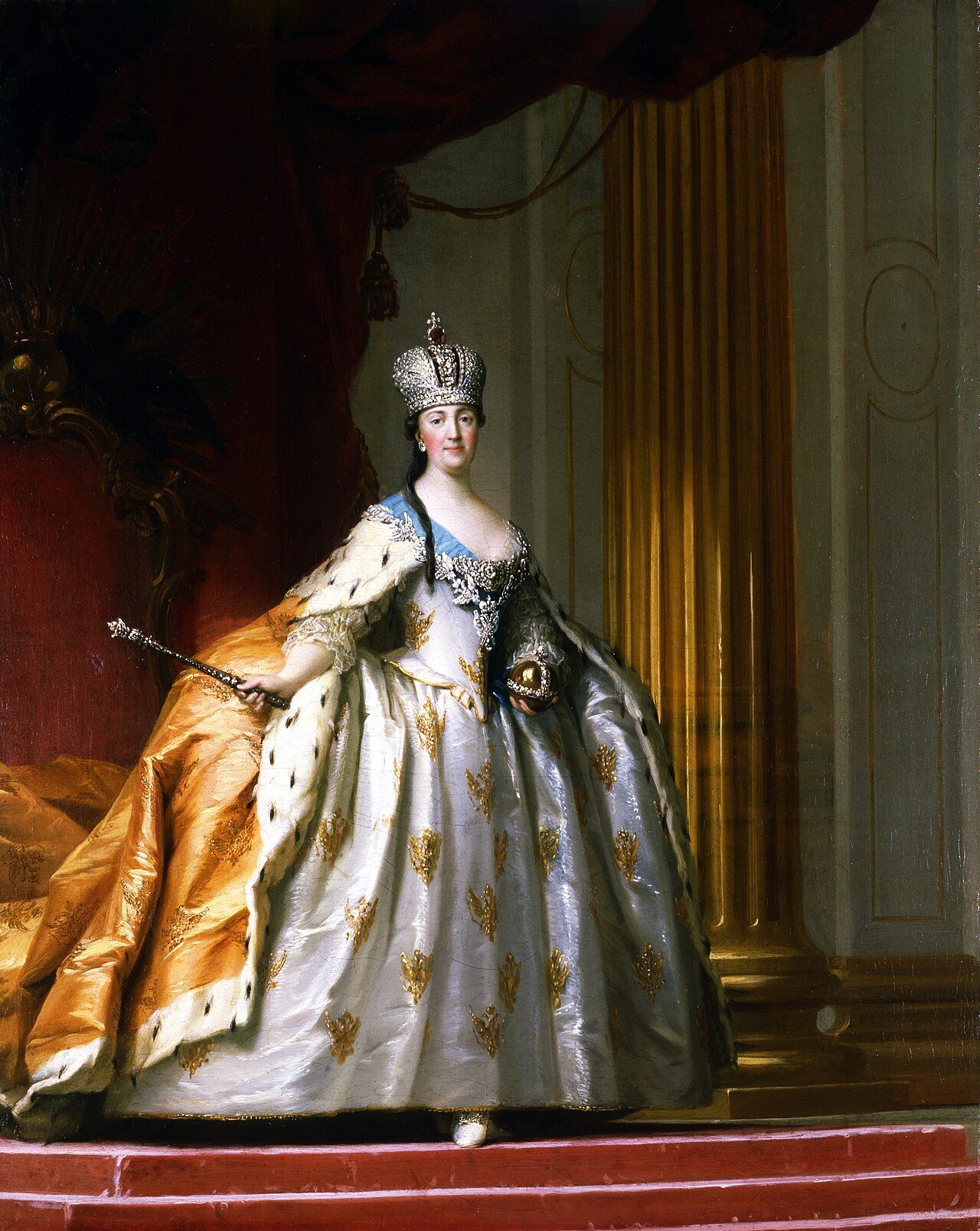 Vigilius Eriksen, 1778–79. The David Collection · public domainCatherine the GreatEmpress of Russia from 1762 to 1796, German-born like Karl himself; she made St Petersburg a capital of the Enlightenment and travelled to Moscow by sledge-carriage wrapped in furs.. Travelling by carriage from St Petersburg to Moscow in the bitter Russian winter, she would wrap her legs in sableThe sable, Martes zibellina. Engraving after J. C. D. von Schreber · public domainSableA small marten of the Siberian forests whose fur is the most precious in the world; for centuries the tsars paid ambassadors and allies in sable pelts.. Lagerfeld, however — designer for the celebrated houses of Chanel and Fendi
 Palazzo Fendi, Rome. Photo Katalin Bán · CC BY-SA 4.0FendiThe Roman fur and leather house run by the five Fendi sisters. Karl designed for them from 1965 until his death in 2019 — the longest designer partnership in fashion. and founder of his own line, Lagerfeld Gallery
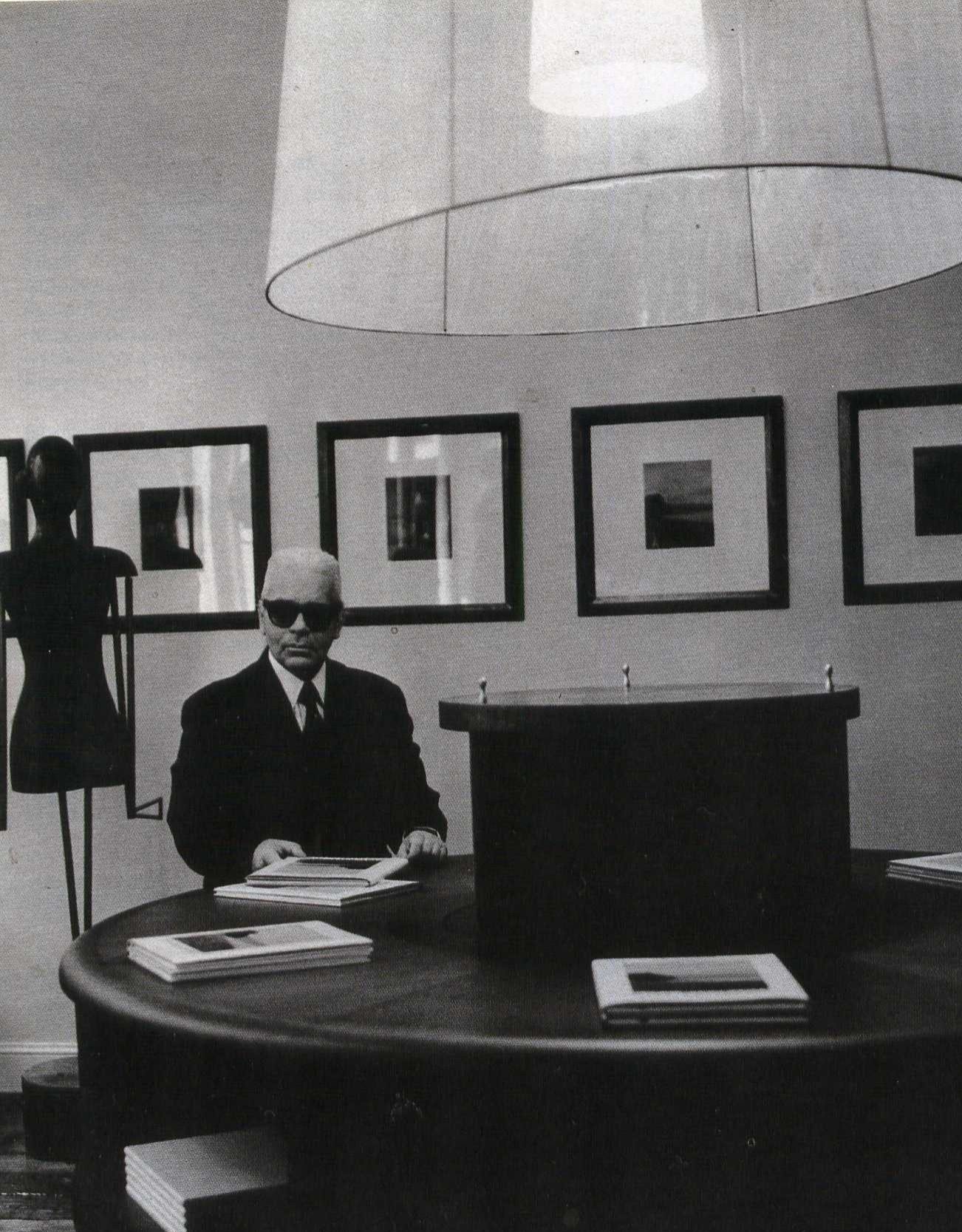 Lagerfeld Gallery, 1998. Vogue Russia, November 1998Lagerfeld GalleryKarl’s own line and shop, opened in April 1998 on the rue de Seine in Paris: clothes, books, photographs and exhibitions under one roof. — appears to be the only person who turns fur into bed linen.
“In winter I sleep under a sableThe sable, Martes zibellina. Engraving after J. C. D. von Schreber · public domainSableA small marten of the Siberian forests whose fur is the most precious in the world; for centuries the tsars paid ambassadors and allies in sable pelts. blanket. It’s warm, light and beautiful. You can’t imagine how well it retains the warmth. And in summer I sleep under ermine A stoat in its winter coat. Photo 4028mdk09 · CC BY-SA 3.0ErmineThe stoat in its white winter coat, black only at the tip of the tail; for centuries the fur of coronation robes.,” he tells me, with the nonchalance of someone for whom nothing could be more ordinary than a fur blanket.
For him, no doubt, nothing is. By now, everyone is accustomed to Lagerfeld turning things inside out — bestowing extravagant luxury upon everyday routine and discovering unexpected glamour in bohemian clothes. He turns leather jackets into Chanel biker chic, while at FendiPalazzo Fendi, Rome. Photo Katalin Bán · CC BY-SA 4.0FendiThe Roman fur and leather house run by the five Fendi sisters. Karl designed for them from 1965 until his death in 2019 — the longest designer partnership in fashion. he dyes the most coveted furs to make them look artificial. But whatever he does, he is always unpredictable.
Who knows? Perhaps one day some biographer will discover that Lagerfeld’s passion for discreet luxury began with his father’s fur-lined coat.
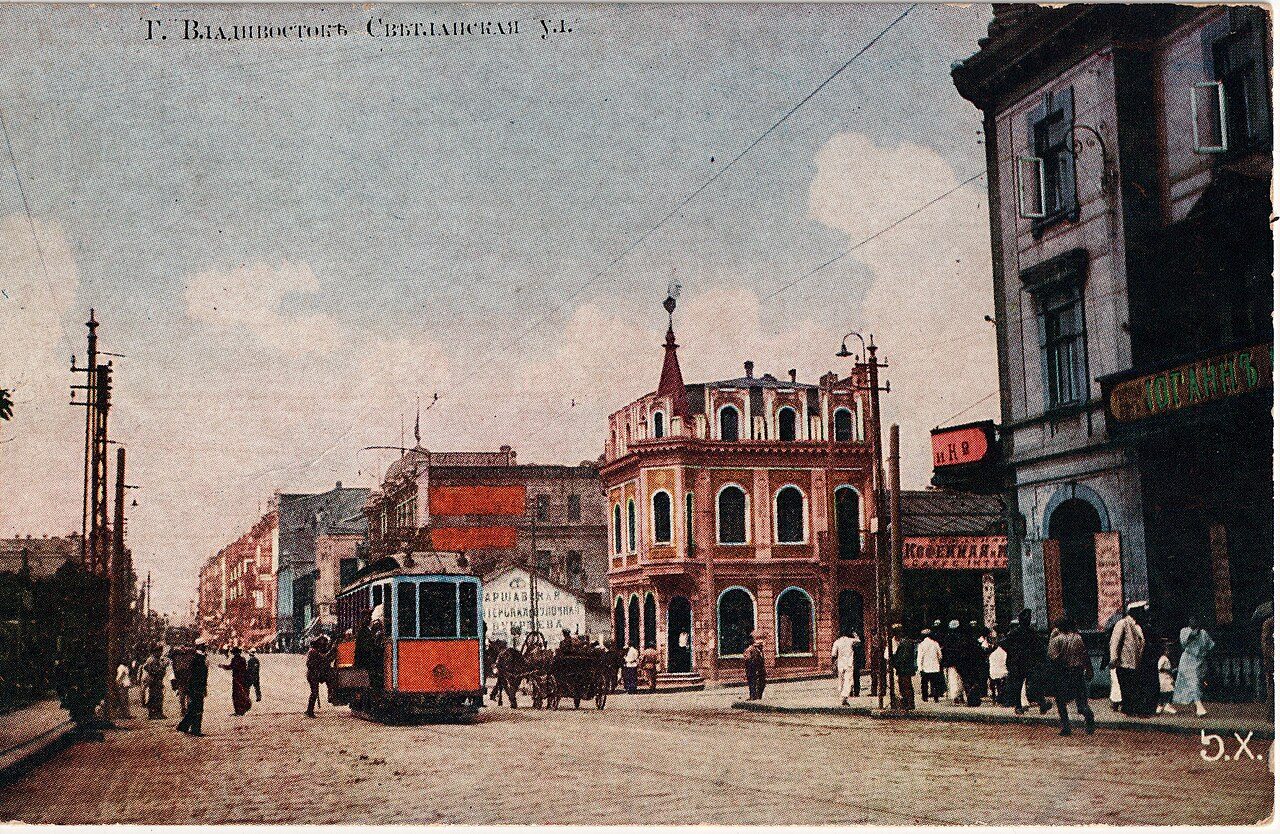
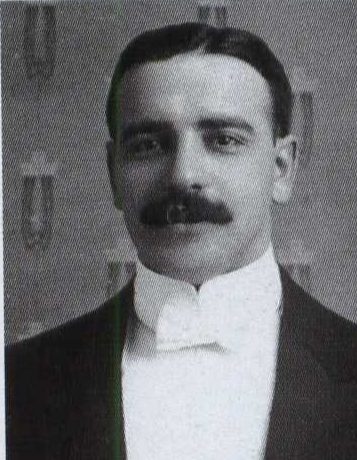
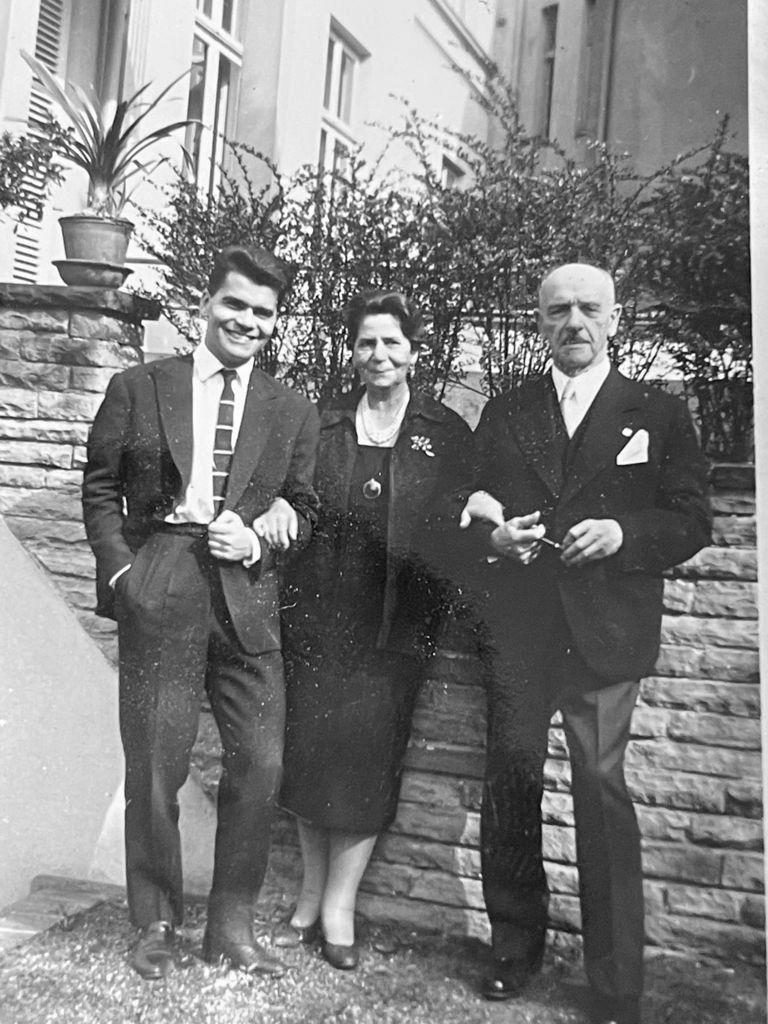
“From 1907 to 1916, before I was born, my father lived in VladivostokVladivostokRussia’s great port on the Pacific Ocean, at the far eastern end of the Trans-Siberian Railway: some 9,000 kilometres east of Moscow and closer to Japan than to Europe. Karl’s father, Otto, lived there in the 1910s.. He brought back a sableThe sable, Martes zibellina. Engraving after J. C. D. von Schreber · public domainSableA small marten of the Siberian forests whose fur is the most precious in the world; for centuries the tsars paid ambassadors and allies in sable pelts.-lined coat. Throughout my childhood it lay in an iron trunk in the attic of our house in Hamburg — he never wore it again. I loved trying it on in secret. A beautiful wool coat lined with sableThe sable, Martes zibellina. Engraving after J. C. D. von Schreber · public domainSableA small marten of the Siberian forests whose fur is the most precious in the world; for centuries the tsars paid ambassadors and allies in sable pelts., with an astrakhan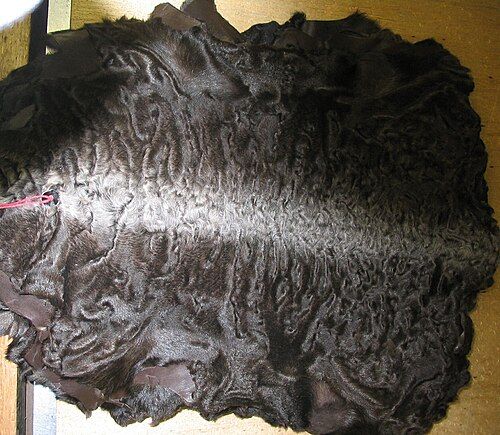 A karakul lamb pelt. Photo Kürschner · public domainAstrakhanTightly curled lambskin from karakul sheep, named after Astrakhan, the Russian city on the Volga where it was traded. collar...”
Among his other childhood memories are a Russian governess (whom he adored!), borscht (which he detested!) and blinis with caviar (which he still adores).
II
The Irreverence of Fur
When the ultimate symbol of status became a canvas for experimentation.
We are sitting at the back of La Palette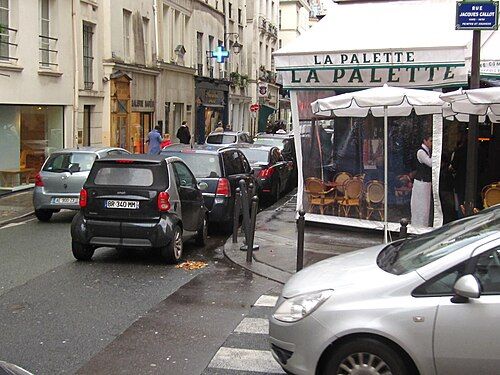 Café La Palette, 2013. Photo mi chiel · CC BY-SA 2.0La PaletteAn old artists’ café on the rue de Seine in Saint-Germain-des-Prés, Paris, close to the art school; Lagerfeld Gallery opened a few doors away., a Parisian café remarkable only for having apparently assembled the rudest and slowest waiters in Paris, and we are talking about fur.
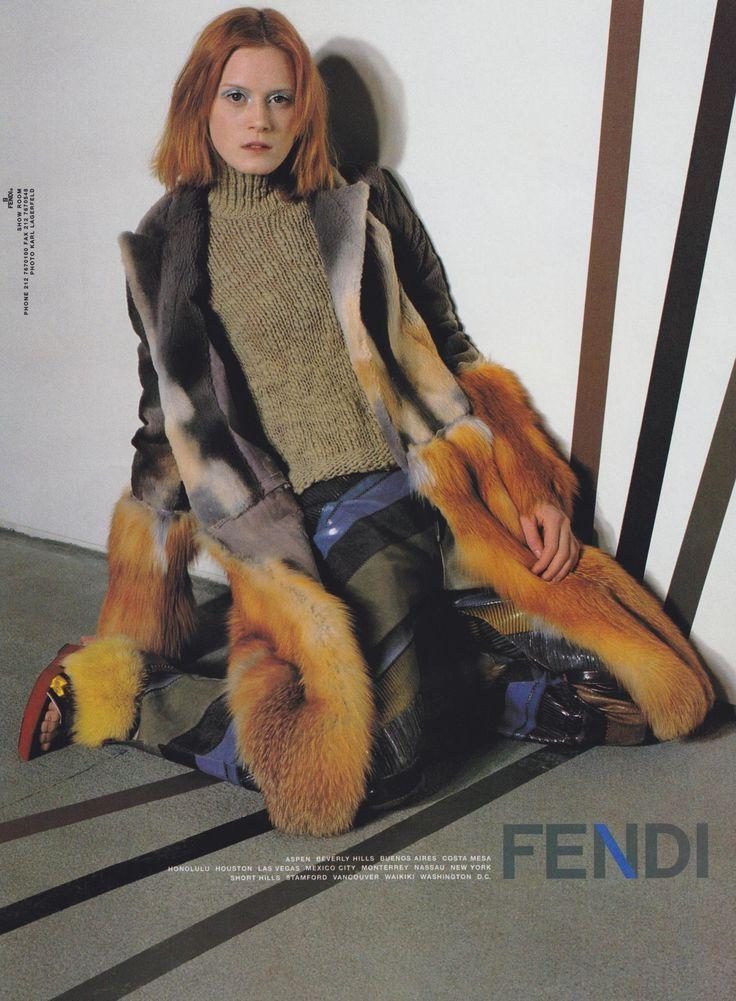
For more than thirty years, Lagerfeld has been designing for the celebrated Italian house of FendiPalazzo Fendi, Rome. Photo Katalin Bán · CC BY-SA 4.0FendiThe Roman fur and leather house run by the five Fendi sisters. Karl designed for them from 1965 until his death in 2019 — the longest designer partnership in fashion. (a FendiPalazzo Fendi, Rome. Photo Katalin Bán · CC BY-SA 4.0FendiThe Roman fur and leather house run by the five Fendi sisters. Karl designed for them from 1965 until his death in 2019 — the longest designer partnership in fashion. boutique recently opened on Moscow’s Kutuzovsky Prospekt Kutuzovsky Prospekt, Moscow. Photo Artyom Svetlov · CC BY 4.0Kutuzovsky ProspektA grand avenue running west from the centre of Moscow, lined with Stalin-era apartment houses; in the 1990s one of the city’s first luxury shopping streets.). For decades he has been changing perceptions of fur, taking it from expensive, boxy coats to irreverent but highly fashionable elements of dress.
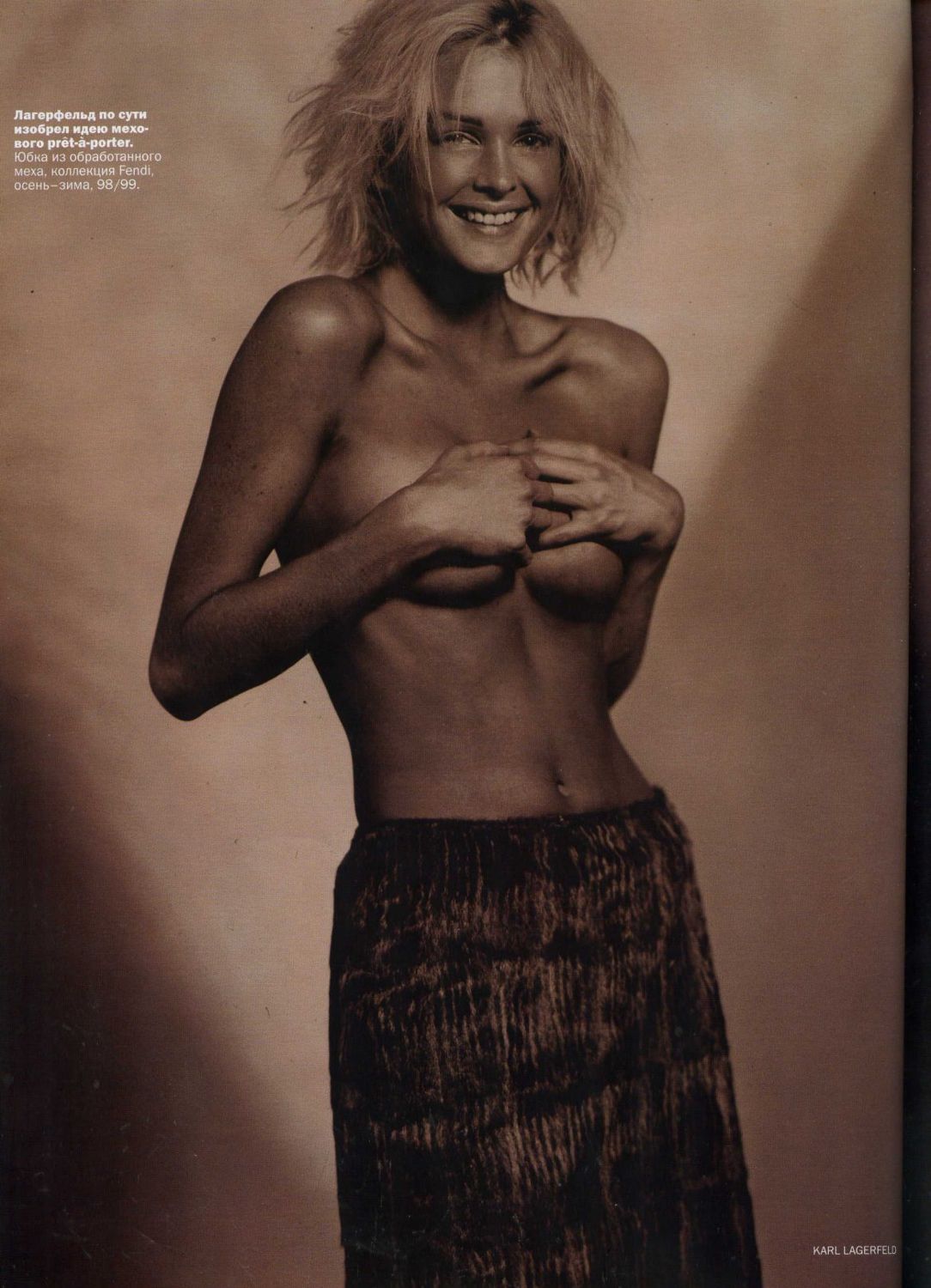
Thanks to Lagerfeld, wherever a woman may live today, the words “fur coat” no longer necessarily mean “ankle-length dark mink to wear to the opera”. He virtually invented the concept of fur prêt-à-porter.
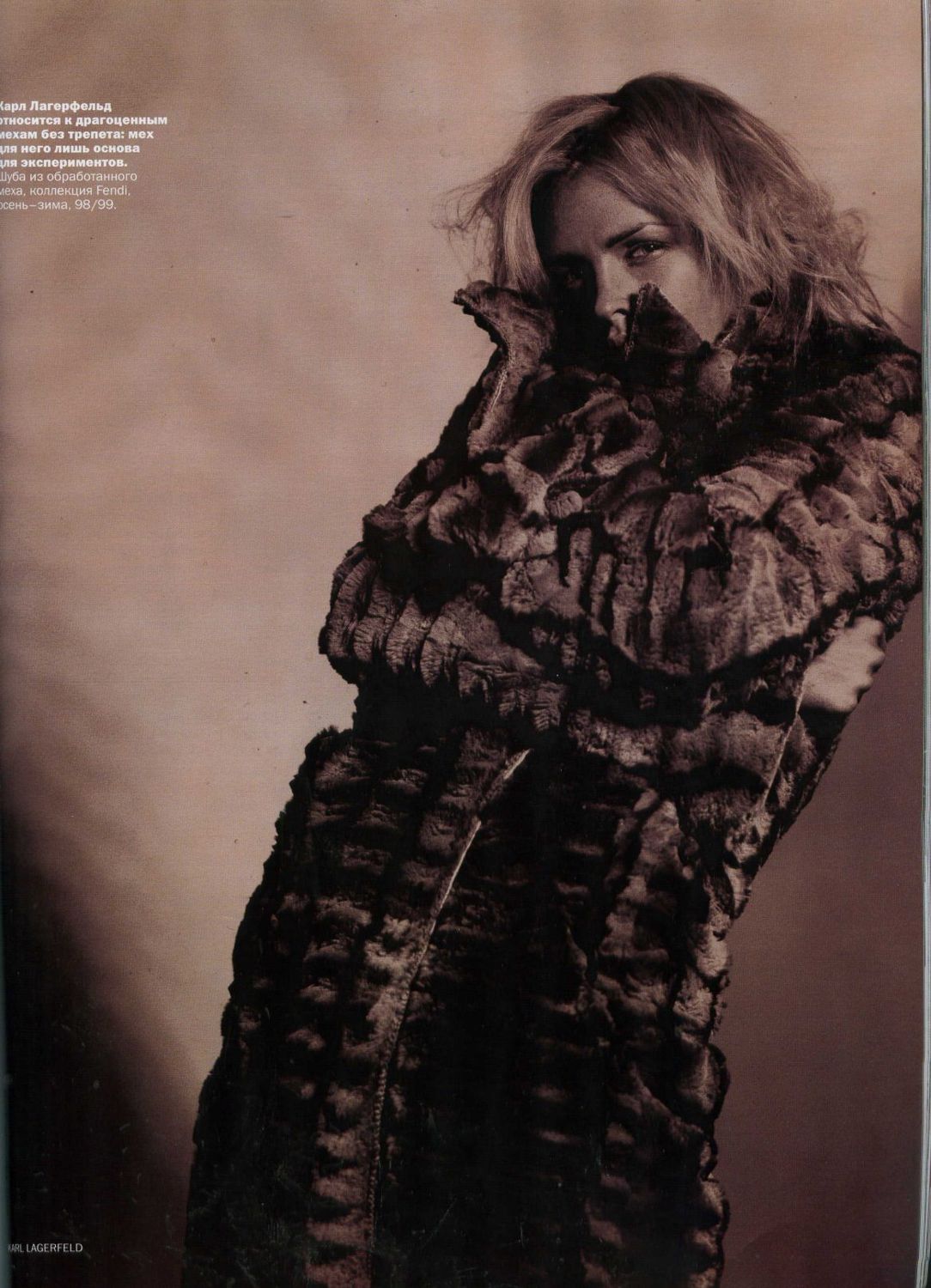
The almost spherical fox jackets in neon colours that appeared in last season’s GucciGucciThe Florentine leather house founded in 1921; in the late 1990s its designer Tom Ford made it the most talked-about label in fashion. collection can be traced back to the dyed furs Lagerfeld created much earlier for FendiPalazzo Fendi, Rome. Photo Katalin Bán · CC BY-SA 4.0FendiThe Roman fur and leather house run by the five Fendi sisters. Karl designed for them from 1965 until his death in 2019 — the longest designer partnership in fashion.. Jean-Paul GaultierJean-Paul GaultierThe Paris designer known since the 1970s as fashion’s enfant terrible; he made Madonna’s cone bra in 1990.’s mink dresses, too, are an echo of Lagerfeld’s foray into fur fashion. He has no reverence whatsoever for precious pelts. On the contrary, he sees fur as he would any other fabric: a blank canvas for the most improbable fantasies.
Among his more conservative creations for FendiPalazzo Fendi, Rome. Photo Katalin Bán · CC BY-SA 4.0FendiThe Roman fur and leather house run by the five Fendi sisters. Karl designed for them from 1965 until his death in 2019 — the longest designer partnership in fashion. this year are one-shouldered mohair dresses dyed from dark to light, like walking strips of litmus paper; leather coats in pastel metallic shades; and mink ensembles embroidered with transparent sequins.
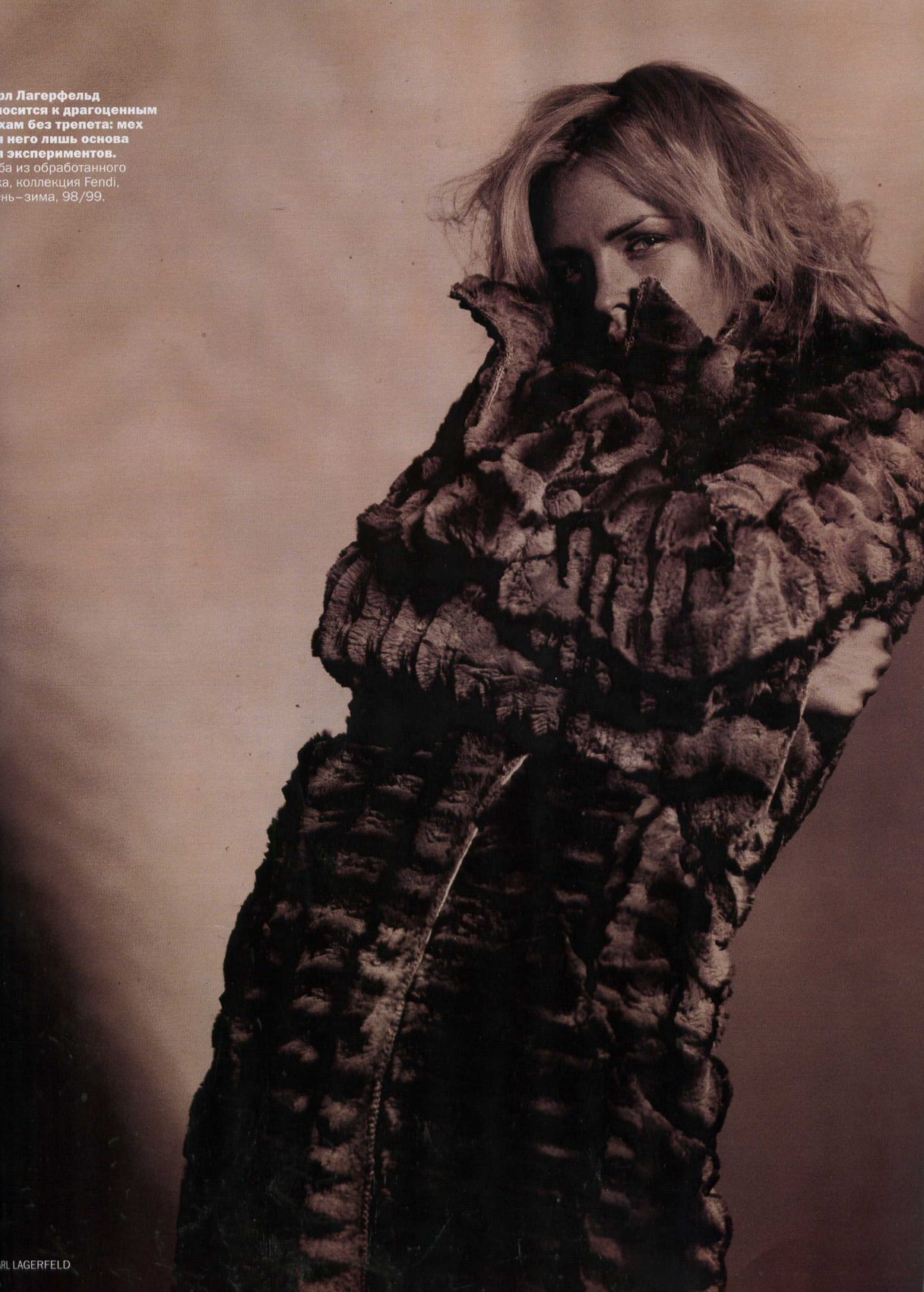
There are more unexpected pieces, too: white mink waistcoats shaved in stripes to resemble ermineA stoat in its winter coat. Photo 4028mdk09 · CC BY-SA 3.0ErmineThe stoat in its white winter coat, black only at the tip of the tail; for centuries the fur of coronation robes.; broadtailBroadtailThe flat, silky, moiré-patterned pelt of very young karakul lambs — the lightest of all lambskins. skirts; short cashmere coats with “transplanted” goat hair; and long-sleeved blouses in orylag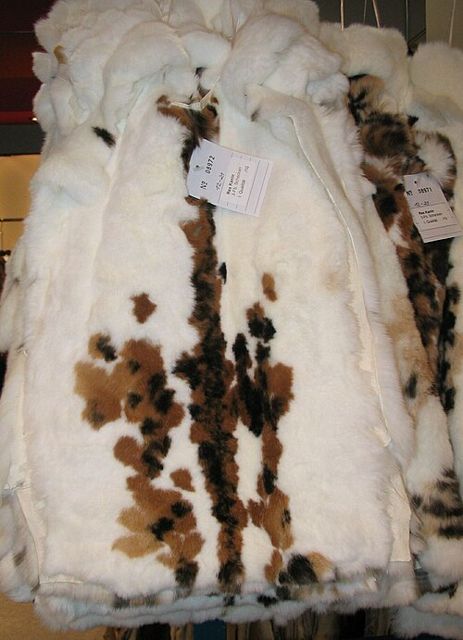 Rex rabbit pelts, the family orylag belongs to. Photo Kürschner · public domainOrylagA rabbit bred in France in the 1980s for a fur as soft and dense as chinchilla — hence the furriers’ polite “hybrid rabbit”.. FendiPalazzo Fendi, Rome. Photo Katalin Bán · CC BY-SA 4.0FendiThe Roman fur and leather house run by the five Fendi sisters. Karl designed for them from 1965 until his death in 2019 — the longest designer partnership in fashion.’s furriers refer to this mysterious animal as a “hybrid rabbit”. Lagerfeld takes a rather simpler view:
“A big Chinese rat, only with a thicker skin.”
He is convinced that fur is no longer a status symbol. Gone are the days when a husband gave his wife a mink coat as official confirmation of his love. Lagerfeld believes that women today are increasingly buying their own furs. And they are more likely to buy several pieces rather than one exceptionally expensive garment: an elegant fur coat for formal occasions; a lightweight short coat or jacket, comfortable enough to drive in and suitable for skiing at weekends; a pony-hide handbag for everyday use.
“Nobody wants an ordinary FendiPalazzo Fendi, Rome. Photo Katalin Bán · CC BY-SA 4.0FendiThe Roman fur and leather house run by the five Fendi sisters. Karl designed for them from 1965 until his death in 2019 — the longest designer partnership in fashion. mink coat today. That’s all seventies. It’s dated. It’s over. It’s not fashionable.”
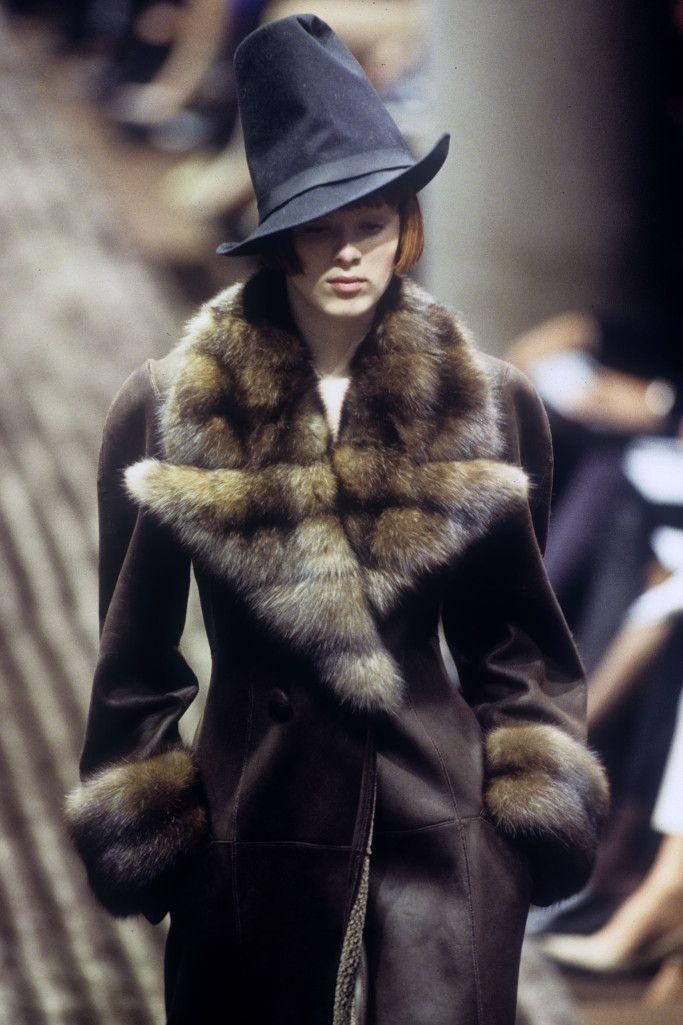
He explains this to me — and, incidentally, to everyone else in the café — loudly and emphatically.
“I do everything I can to make fur look different from the way it did twenty years ago, when it was the pretentious uniform of the nouveaux riches.”
Every season, Lagerfeld ventures into territory no other fur designer has explored before.
“This year it’s crème brûlée-coloured chinchilla Chinchilla. Photo Guérin Nicolas · CC BY-SA 3.0ChinchillaA small animal of the Andes with the densest, softest fur of any land mammal.. It came out astonishingly beautiful! And for next season I’m working on some extraordinary fur appliqués bonded to silk. It’s going to be absolutely incredible!”
Today fur is back in fashion, and Lagerfeld is back in the saddle, once again showing other designers the way. In the early nineties, things were different: environmental activists had given fur a bloody image, and Lagerfeld became their scapegoat. In 1992, critics condemned the torn furs in his FendiPalazzo Fendi, Rome. Photo Katalin Bán · CC BY-SA 4.0FendiThe Roman fur and leather house run by the five Fendi sisters. Karl designed for them from 1965 until his death in 2019 — the longest designer partnership in fashion. collection, which looked like the hides of cave bears. In 1994, they were after him again, this time for using porn stars and striptease performers Milan Cathedral. Otto Henry Bacher, 1886. The Metropolitan Museum of Art · public domainFendi, Milan, October 1993For Fendi’s Spring–Summer 1994 collection, Karl skipped the runway: the clothes stood on mannequins while the Italian film star Moana Pozzi and a troupe of striptease dancers modelled the swimwear in a separate room. as FendiPalazzo Fendi, Rome. Photo Katalin Bán · CC BY-SA 4.0FendiThe Roman fur and leather house run by the five Fendi sisters. Karl designed for them from 1965 until his death in 2019 — the longest designer partnership in fashion. models.
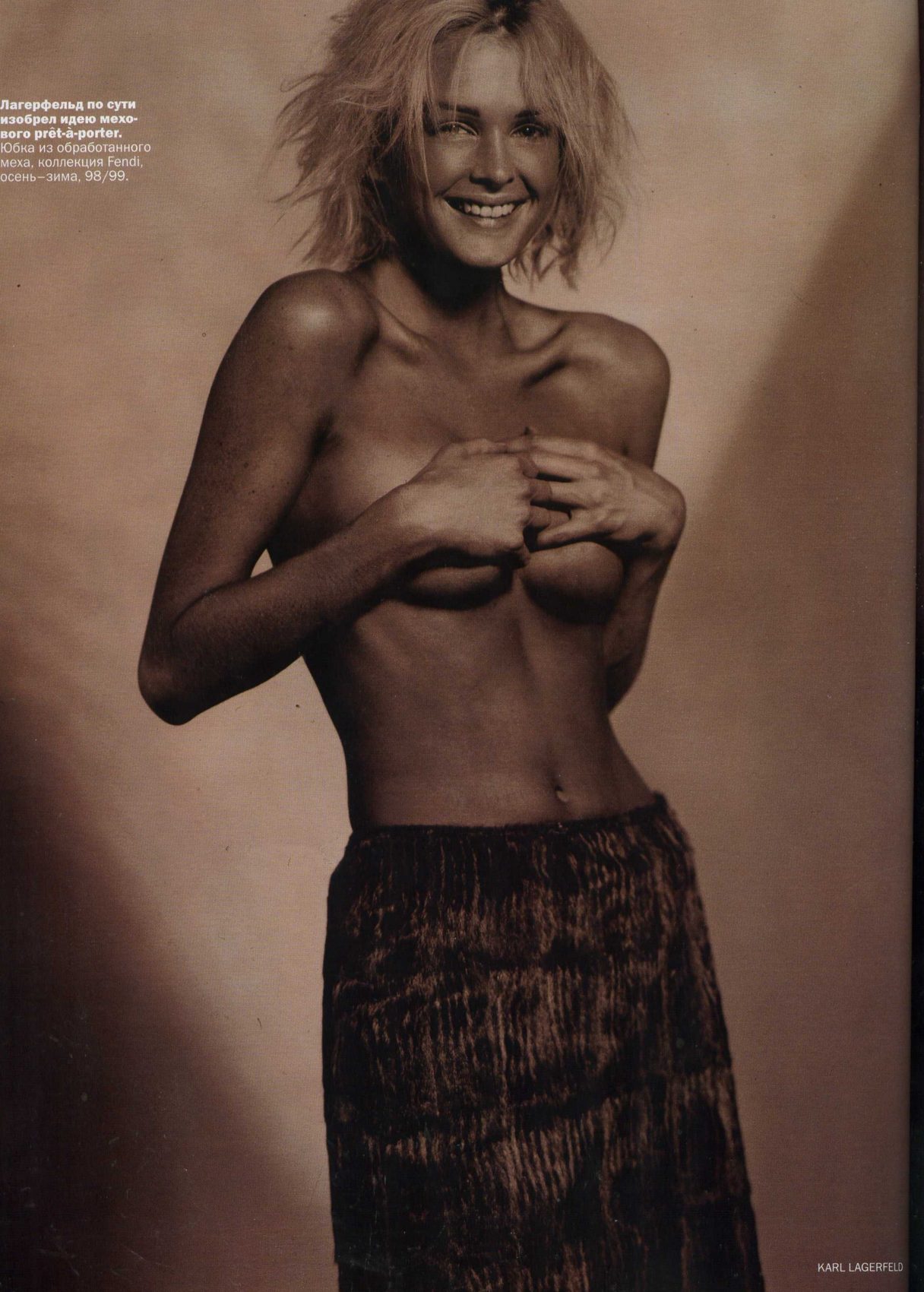
“When I do a collection, the main thing is to avoid the usual reaction: ‘Oh, how expensive! Oh, the poor little animals!’ It may be a risk, but the Fendi sistersFendi coat in treated fur, Autumn–Winter 1998/99. Vogue Russia, November 1998The Fendi sistersPaola, Anna, Franca, Carla and Alda Fendi, who took over their parents’ Roman fur shop and hired Karl in 1965. can afford it.”
Lagerfeld is no stranger to risk. Yet collections conceived as a provocation, a slap in the face of public taste, are often greeted with enthusiasm and give rise to entirely new fashion trends.
A century in one line
From a coat in the attic to the end of fur
This interview stands almost exactly in the middle of the story.
III
The Collector’s Sanctuary
Two centuries of obsession, 230,000 books and a retreat from the world.
Being obsessed with the eighteenth century doesn’t mean I have to live in it.
Karl Lagerfeld · Vogue Russia, November 1998
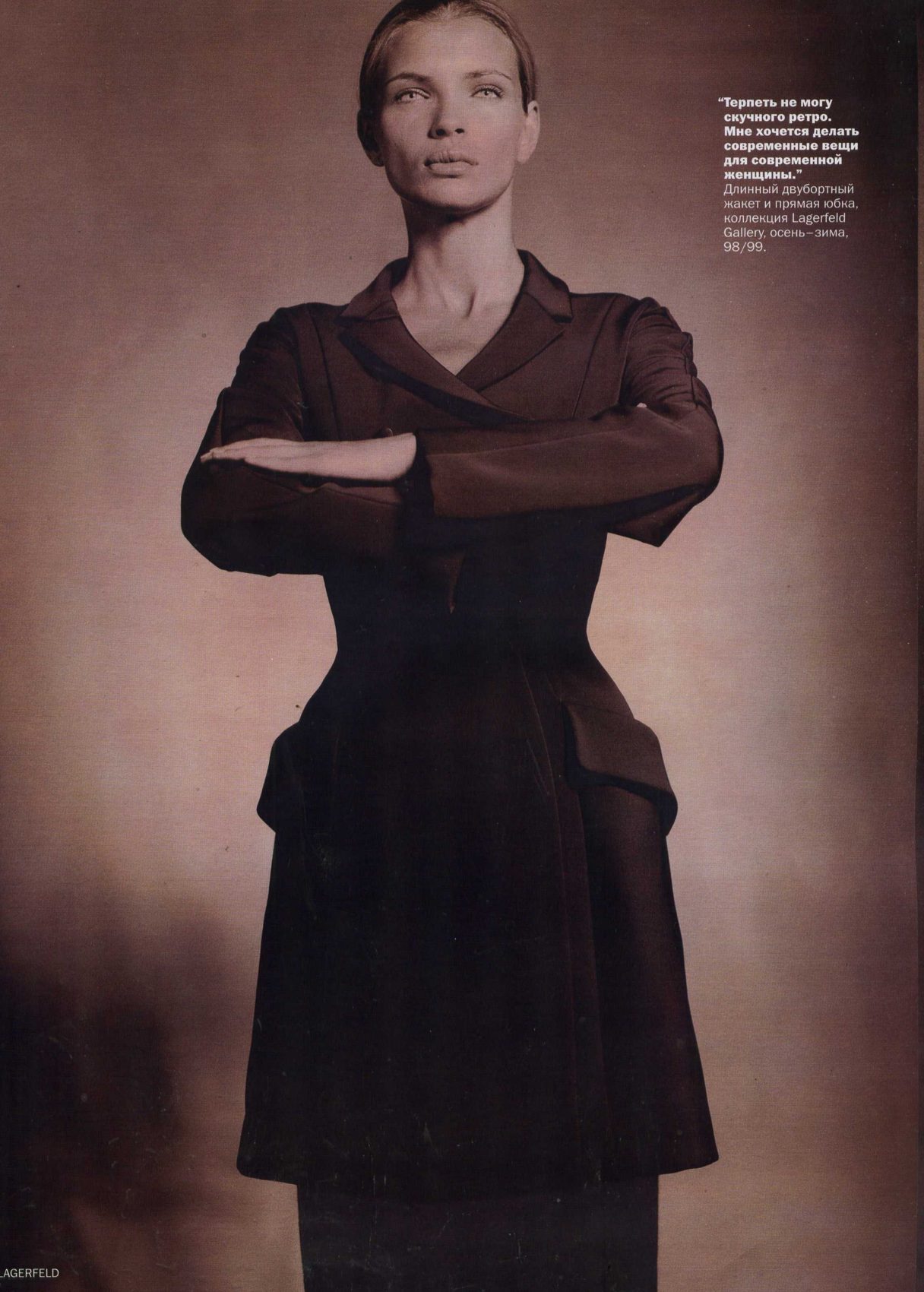
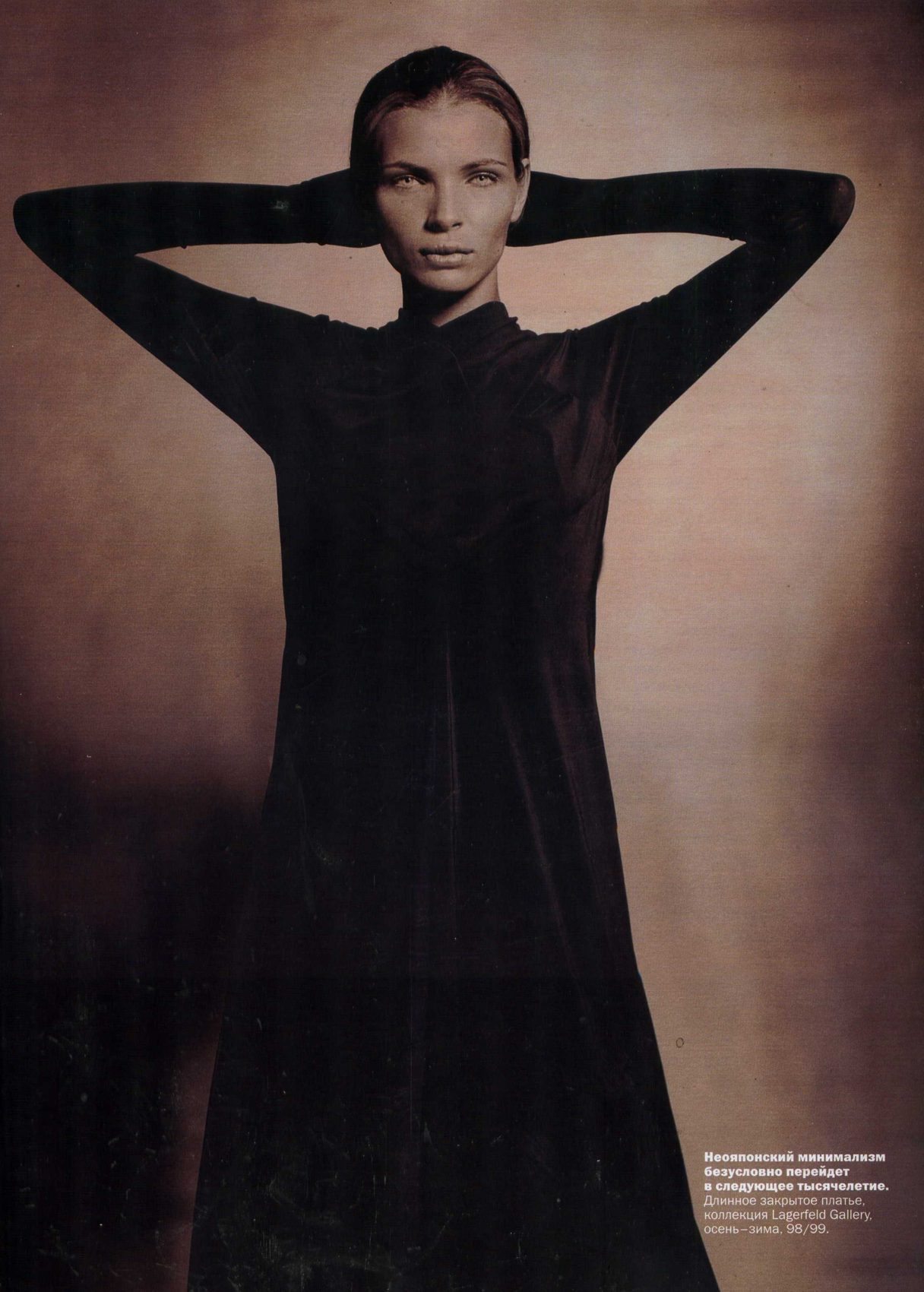
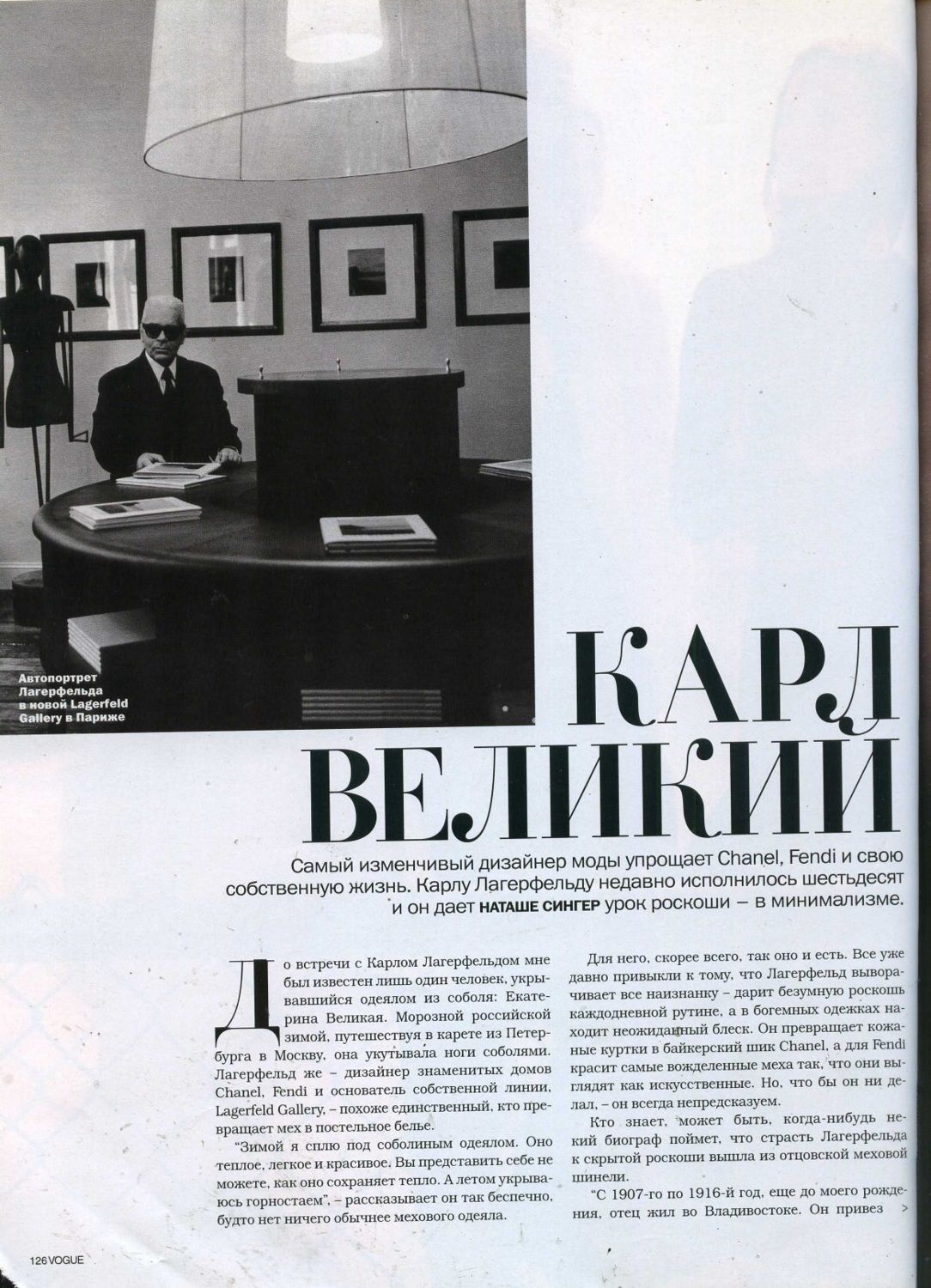
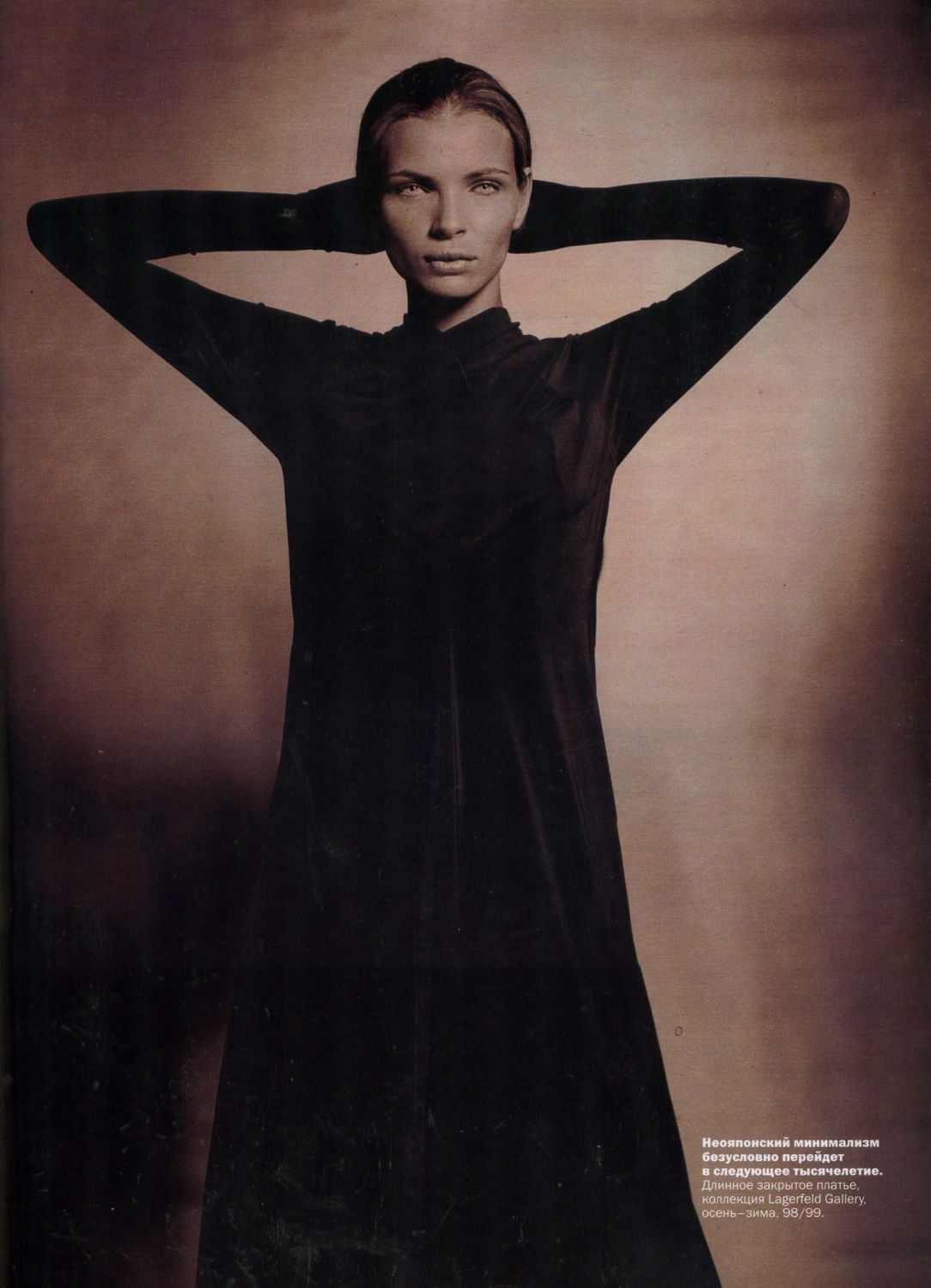
His latest project is Lagerfeld GalleryLagerfeld Gallery, 1998. Vogue Russia, November 1998Lagerfeld GalleryKarl’s own line and shop, opened in April 1998 on the rue de Seine in Paris: clothes, books, photographs and exhibitions under one roof.. The understated elegance of the clothes in this line echoes what he has been doing for FendiPalazzo Fendi, Rome. Photo Katalin Bán · CC BY-SA 4.0FendiThe Roman fur and leather house run by the five Fendi sisters. Karl designed for them from 1965 until his death in 2019 — the longest designer partnership in fashion.. Neo-Japanese minimalism may seem somewhat anachronistic today, but it will undoubtedly carry over into the next millennium. And the relaxed atmosphere of his art gallery is a welcome departure from the conventionally cold museum interior, with its stiff attendants and their undisguised dislike of idle visitors.
“I hate the very idea of an Art Gallery with capital letters. It’s so pretentious. Yes, it’s a gallery — but a private, intimate one, not a commercial gallery,” he explains as we make our way towards Lagerfeld GalleryLagerfeld Gallery, 1998. Vogue Russia, November 1998Lagerfeld GalleryKarl’s own line and shop, opened in April 1998 on the rue de Seine in Paris: clothes, books, photographs and exhibitions under one roof., wandering down the rue de Seine Rue de Seine, Paris. Photo Ralf Treinen · CC BY-SA 3.0Rue de SeineA street of art galleries in Saint-Germain-des-Prés, on the Left Bank of Paris, running down to the river., past art galleries and little shops selling souvenirs and trinkets.
Lagerfeld GalleryLagerfeld Gallery, 1998. Vogue Russia, November 1998Lagerfeld GalleryKarl’s own line and shop, opened in April 1998 on the rue de Seine in Paris: clothes, books, photographs and exhibitions under one roof., which opened only in April 1998, is striking in its Spartan austerity. In its serene silence, it resembles a Buddhist temple. Simple wooden floors, interiors the colour of café au lait. A few antiques, a cast-iron radiator, oak bookcases — all remnants of a “previous life”, when the premises housed a publishing company.
Otherwise, the prevailing spirit is futuristic, as though anticipating a time when intelligent electronics will relieve us of familiar and tiresome “material” possessions.
Only a handful of objects are on display, among them a bottle of Lagerfeld’s JakoJakoKarl’s fragrance for men, launched in 1998, the year of this interview. fragrance and an issue of VisionaireVisionaireA collectible art-and-fashion publication founded in New York in 1991; every issue a different object, printed in a numbered edition., a limited-edition magazine. There are very few things, and one can see that they have been chosen with particular care and affection. This lends them the stature of little idols on pedestals, placed there to be admired rather than worshipped.
Despite its intimate atmosphere, the gallery is always open to visitors. They can leaf through the designer’s favourite magazines and books, buy some small object — a pair of sunglasses, perhaps — or see an exhibition.
Downstairs, they can try on a strictly tailored suit or a straight-cut dress from the Lagerfeld GalleryLagerfeld Gallery, 1998. Vogue Russia, November 1998Lagerfeld GalleryKarl’s own line and shop, opened in April 1998 on the rue de Seine in Paris: clothes, books, photographs and exhibitions under one roof. collection, which shares the refined simplicity of the gallery itself.
The gallery features both young artists and forgotten masters of the past. I had the opportunity to see sketches by Georges Lepape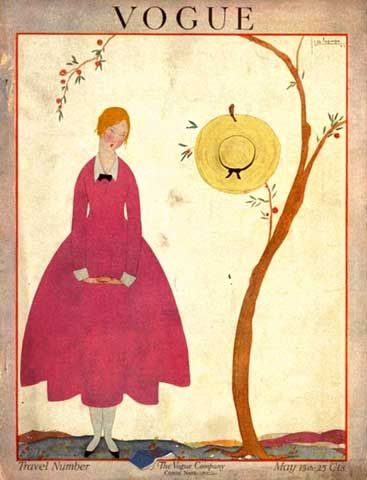 Lepape’s cover for Vogue, May 1917 · public domainGeorges LepapeFrench illustrator (1887–1971), one of the great hands of Art Deco: he drew Paul Poiret’s dresses and many Vogue covers of the 1910s–1930s., one of the artists who designed Art Deco
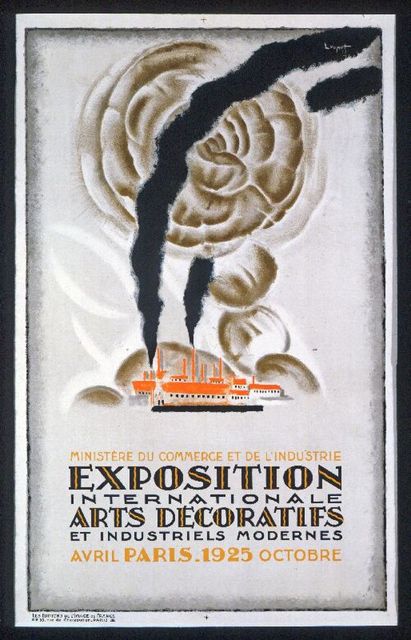 Poster for the Paris exhibition of 1925 · public domainArt DecoThe sleek, geometric luxury style of the 1920s and 1930s, named after the great decorative arts exhibition held in Paris in 1925. costumes for the celebrated Russian ballet seasonsThe Russian ballet seasonsSerge Diaghilev’s Ballets Russes, which took Paris by storm from 1909 with Nijinsky, Stravinsky and costumes by Bakst — and later by Gabrielle Chanel. of the 1920s.
Lagerfeld is a passionate collector of practically everything — paintings, houses, fans, furniture. Having accumulated too much, he is gradually disposing of his countless antique treasures and acquiring new, more contemporary things.
There are, admittedly, things he would not part with for any amount of money. First and foremost, his library of more than 230,000 books.
In proportion
What 230,000 books look like
Each spine on this shelf stands for a thousand books.
As for his own style, he is gradually shedding that, too. Long gone are both the sturdy little boy on the beach of his childhood and the dandy in a Savile Row Savile Row, London. Photo Maggie Jones · public domainSavile RowThe London street of the finest men’s tailors since the nineteenth century; a “Savile Row suit” means hand-made English tailoring. suit reaping the first laurels of his success as a designer.
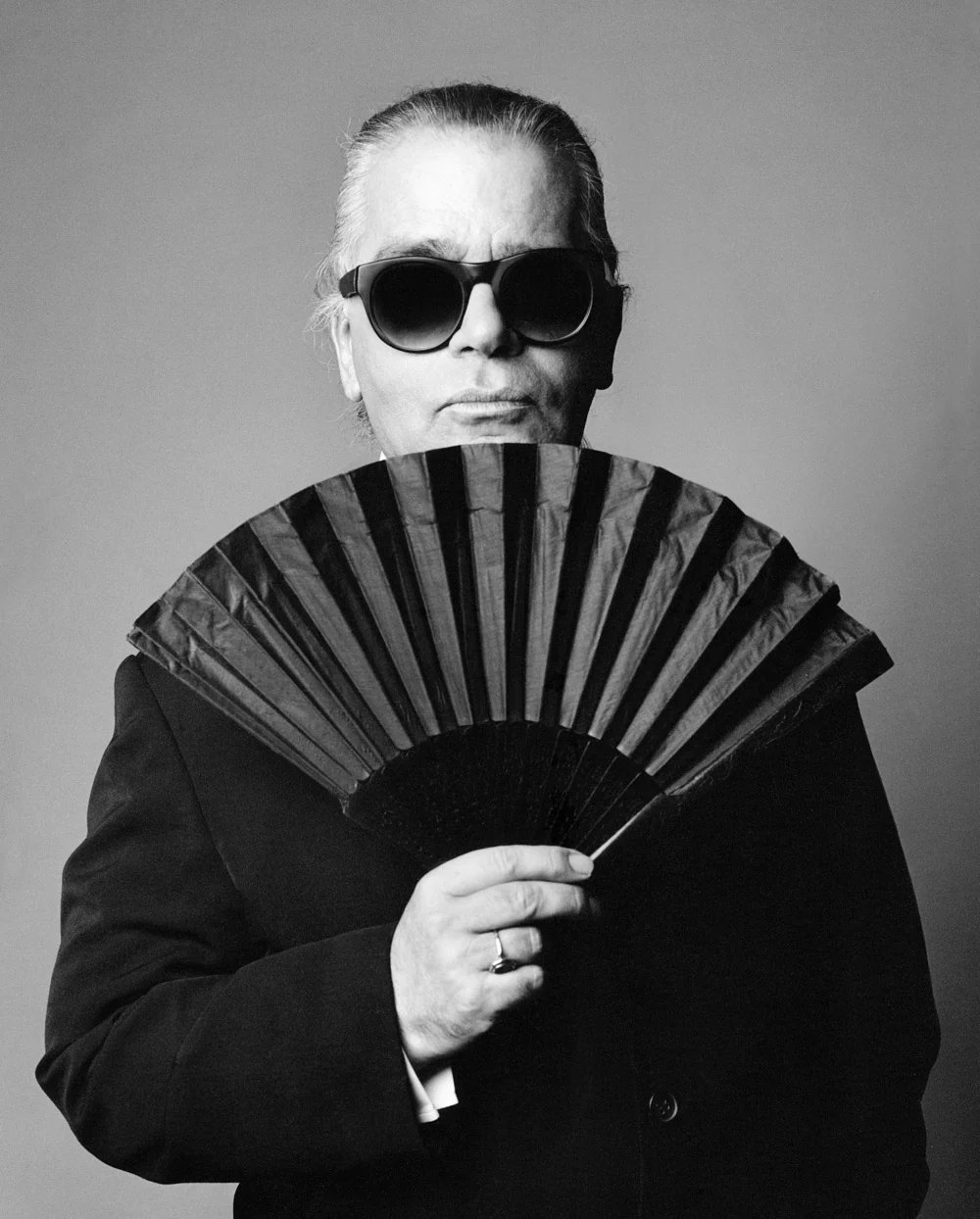
Descriptions of his present appearance invariably mention the powdered white hair, the enormous black sunglasses and the ubiquitous fan. What caught my eye, however, was his long black kimono jacket.
From now on, Lagerfeld intends to wear only black and white because, as he puts it:
“Being obsessed with the eighteenth century doesn’t mean I have to live in it.”
The designer does, however, have his gallery in which to bring all his “obsessions” together under one roof: fashion, photography, design, books and magazines.
And here, tucked away at the back of Lagerfeld GalleryLagerfeld Gallery, 1998. Vogue Russia, November 1998Lagerfeld GalleryKarl’s own line and shop, opened in April 1998 on the rue de Seine in Paris: clothes, books, photographs and exhibitions under one roof., is his cosy study, with its Japanese-style ceiling covered in pleated rice paper. Here he can sketch and think, away from the clamouring crowds, away from Chanel and FendiPalazzo Fendi, Rome. Photo Katalin Bán · CC BY-SA 4.0FendiThe Roman fur and leather house run by the five Fendi sisters. Karl designed for them from 1965 until his death in 2019 — the longest designer partnership in fashion..
“I tried to curb my passion for the eighteenth century and create something simple, something contemporary,” he says, sitting at his long desk and answering letters from the vast stream of his daily correspondence.
The gallery, like the inherited sableThe sable, Martes zibellina. Engraving after J. C. D. von Schreber · public domainSableA small marten of the Siberian forests whose fur is the most precious in the world; for centuries the tsars paid ambassadors and allies in sable pelts.-lined coat, is a luxury — but a deeply intimate, hidden luxury. His refuge and sanctuary.
IV
Chanel Without Chanel
When the disappearance of the signature becomes the ultimate signature.
Much the same atmosphere prevails in the Chanel atelier on the rue Cambon The Chanel house, rue Cambon. Photo ashton · CC BY 2.0Rue CambonThe Paris street of the house of Chanel: Gabrielle Chanel opened at No. 31 in 1918 and the house’s studio and salons are still there., where we meet the following day. Lagerfeld is currently working on the Spring–Summer 1999 collection.
And whatever became of those famous Chanel buttons with the interlocking Cs, and the gold chain straps? They’re gone.
Natasha Singer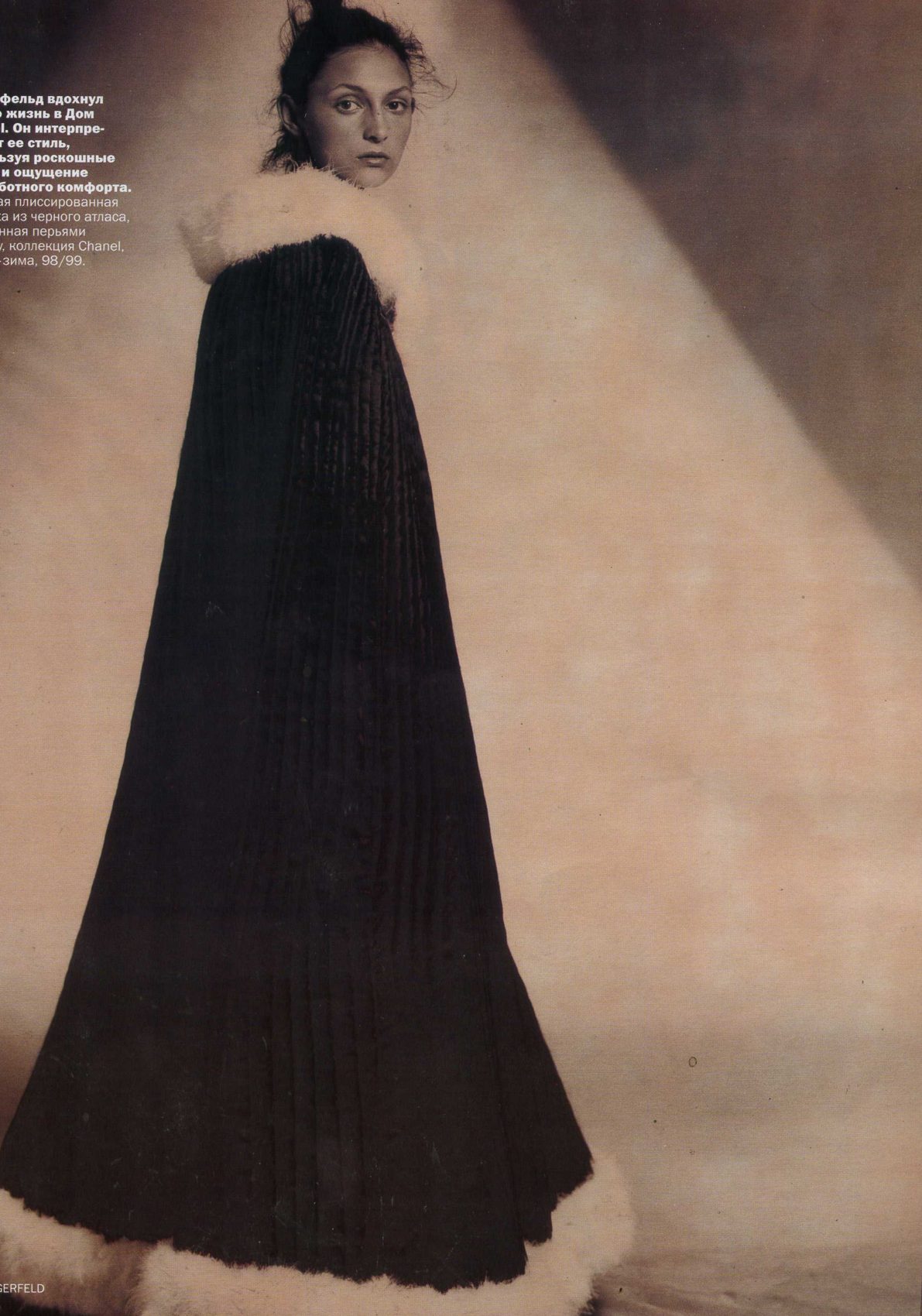
The collection, which will arrive in the boutiques in January 1999, is all muted tones — creamy chocolate, silvery grey — with very little trimming or embellishment.
A crowd of assistants bustles around two models, dressing and undressing them, stitching, pinning, unpicking and draping — all at the maestro’s command.
He himself sits at a long table, somehow managing to talk on the telephone, sketch in his notebook and issue instructions to his entourage simultaneously, gesticulating wildly all the while.
All his instructions amount to much the same thing: a collection already distinguished by its extraordinary minimalism must have even fewer details.
“The collar’s a little too big, a little too heavy-looking, don’t you think?”
The rhetorical question concerns a sleeveless zip-front top.
“The trousers are too narrow,” he says of a pair of silvery ankle-length trousers worn with the simplest flat sandals. “And the elastic is too tight.”
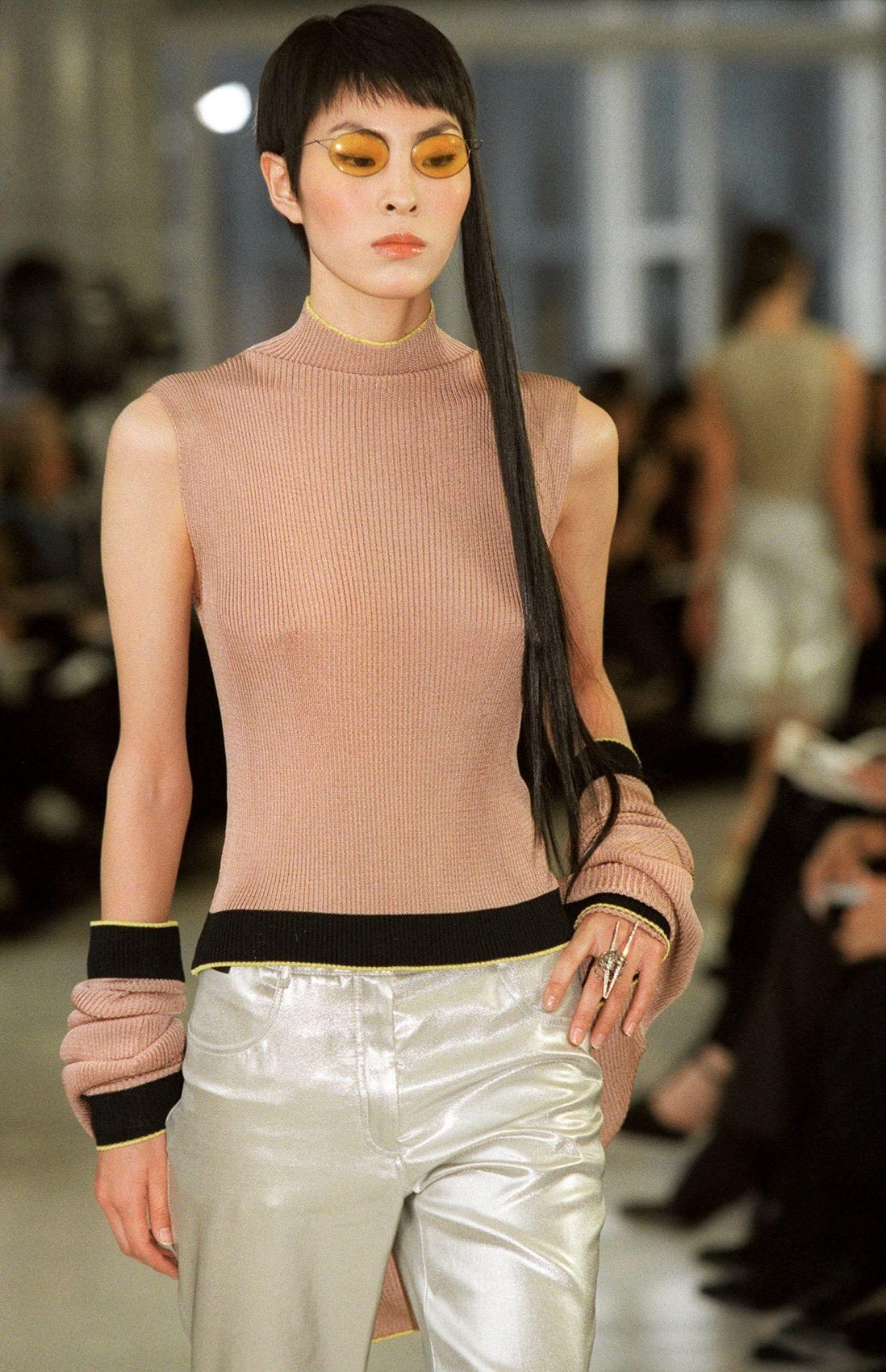
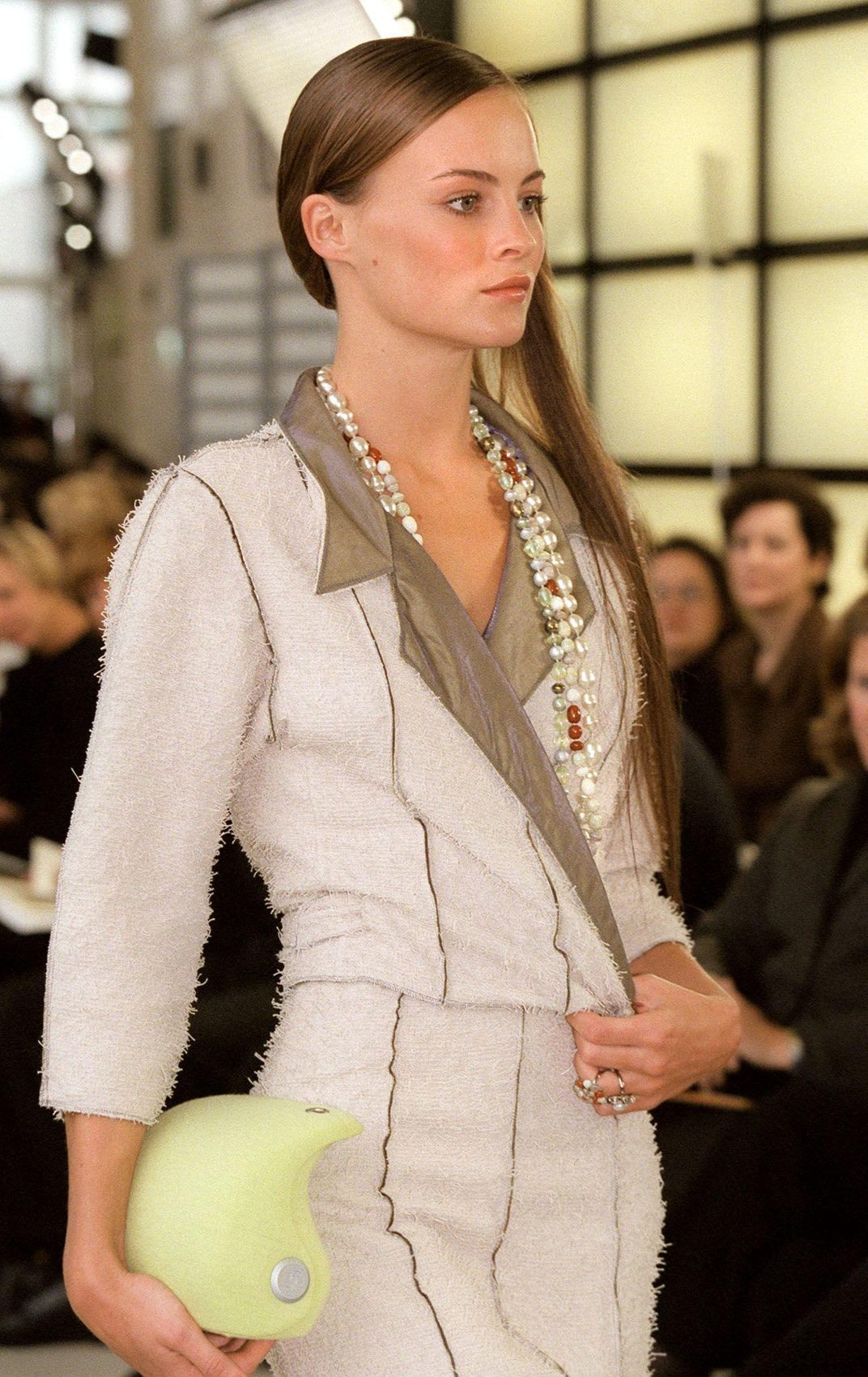
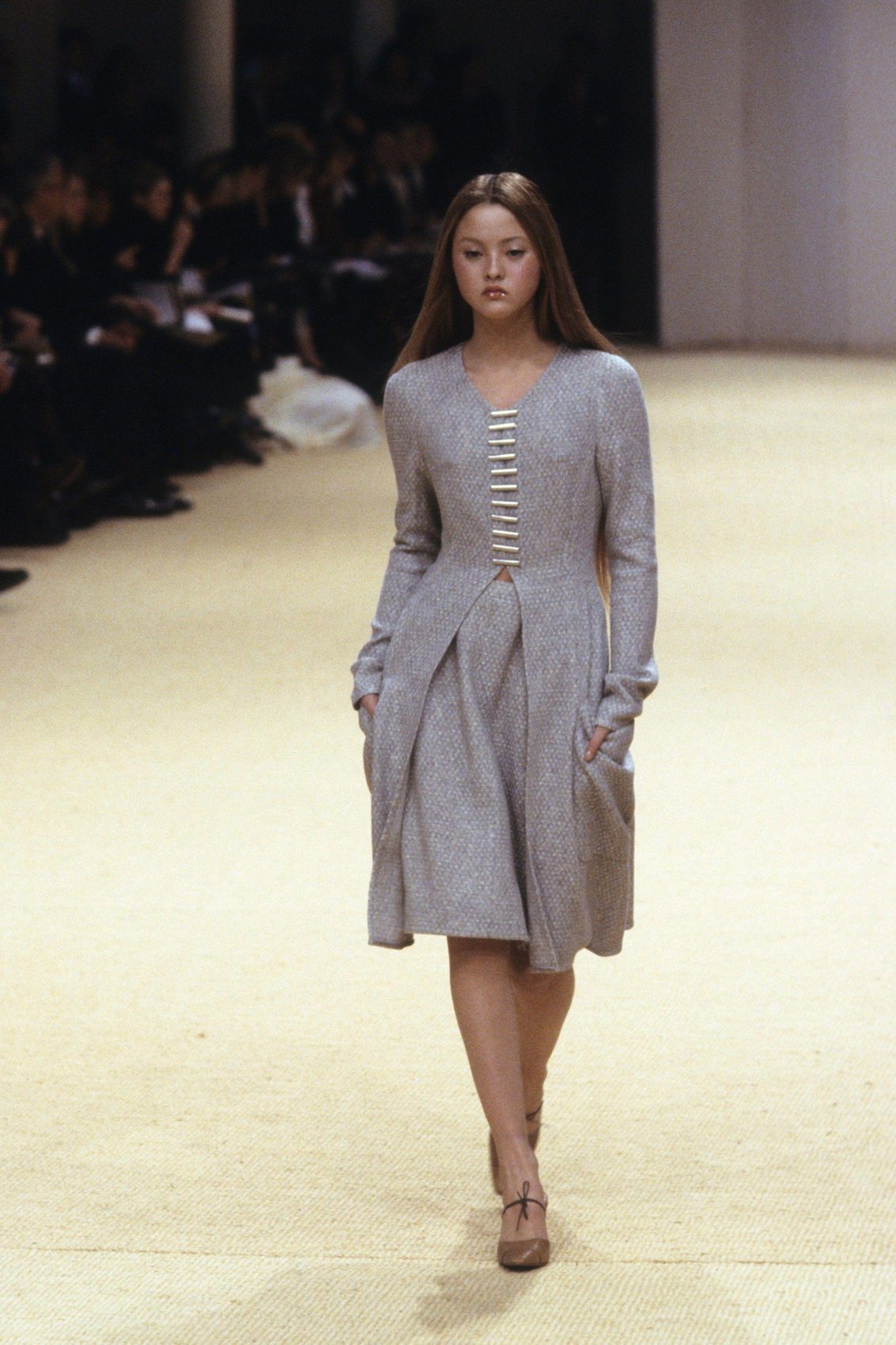
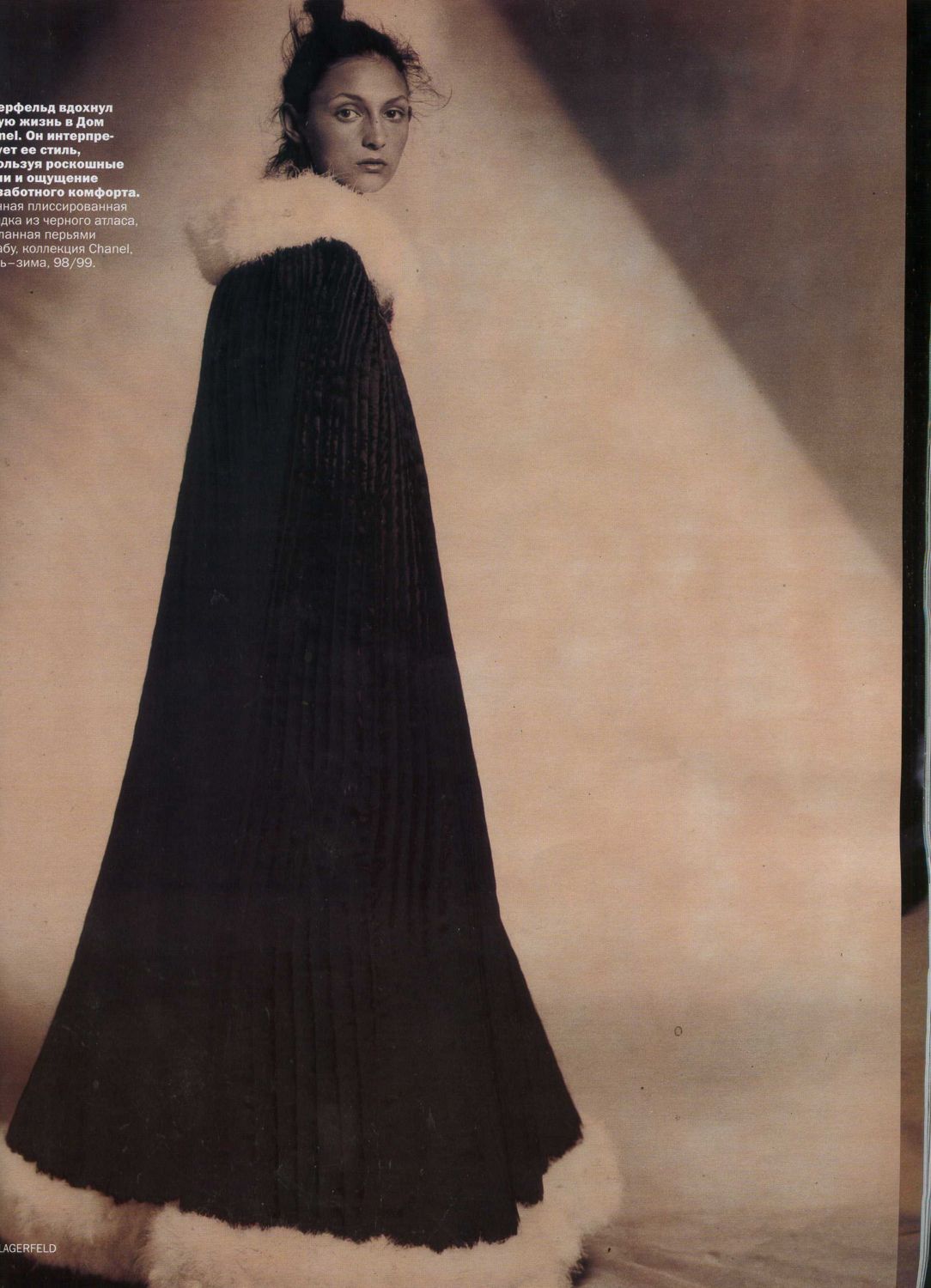
Once again, Lagerfeld has breathed new life into the House of Chanel, which he took over twelve years after the death of its founder.
Rather than adhering to the House’s “golden” standards, he pays tribute to Madame Chanel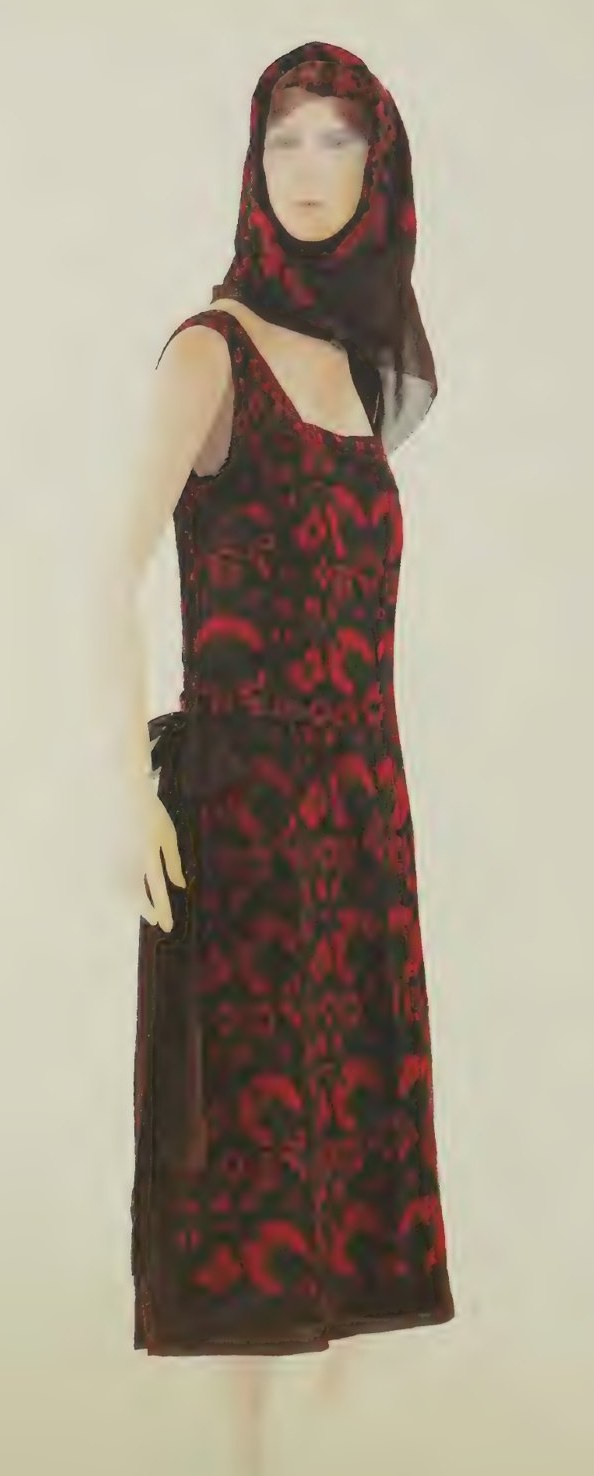 A Chanel dress of the 1920s with Kitmir embroidery. The Metropolitan Museum of Art · public domainGabrielle ChanelFounder of the house (1883–1971), known as Coco. She died in January 1971; Karl took over the house in 1983. by reinterpreting her principles of cut and comfort.
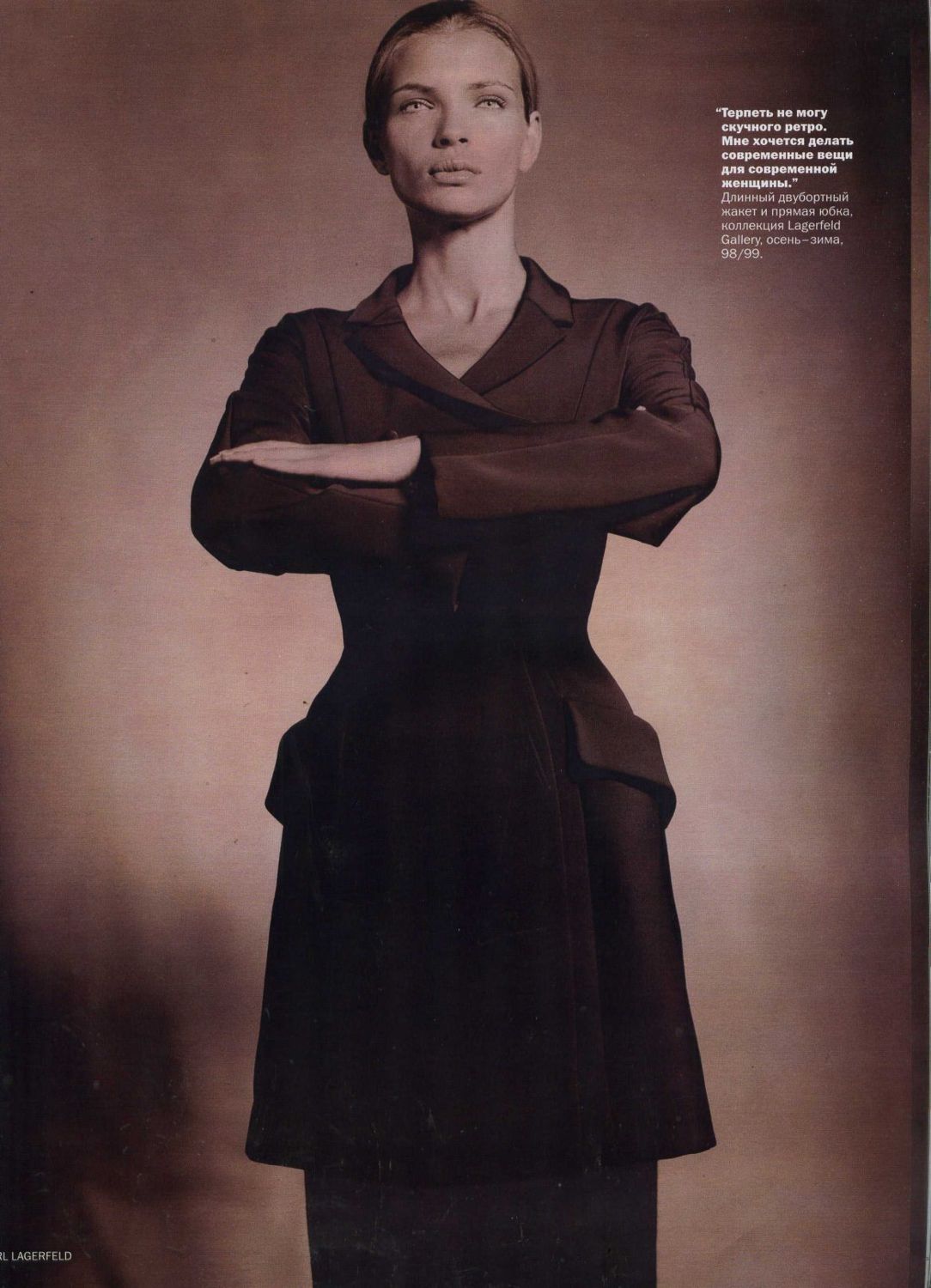
There is still that characteristic close-fitting silhouette, the luxurious, wonderfully tactile silk and stretch satin, and the sense of effortless comfort. And for all its ultra-fashionable minimalism, the new collection is still Chanel.
“I can’t stand boring retro. Once I’ve turned a page, I don’t go back. I want to make modern, interesting clothes for an energetic, modern woman,” he remarks, continuing to look over next year’s collection.
The collection is intended, above all, for a woman who shuns conspicuous, unmistakable designer insignia. She wears Chanel, but the fact that she is indulging herself should remain a secret to all but the initiated.
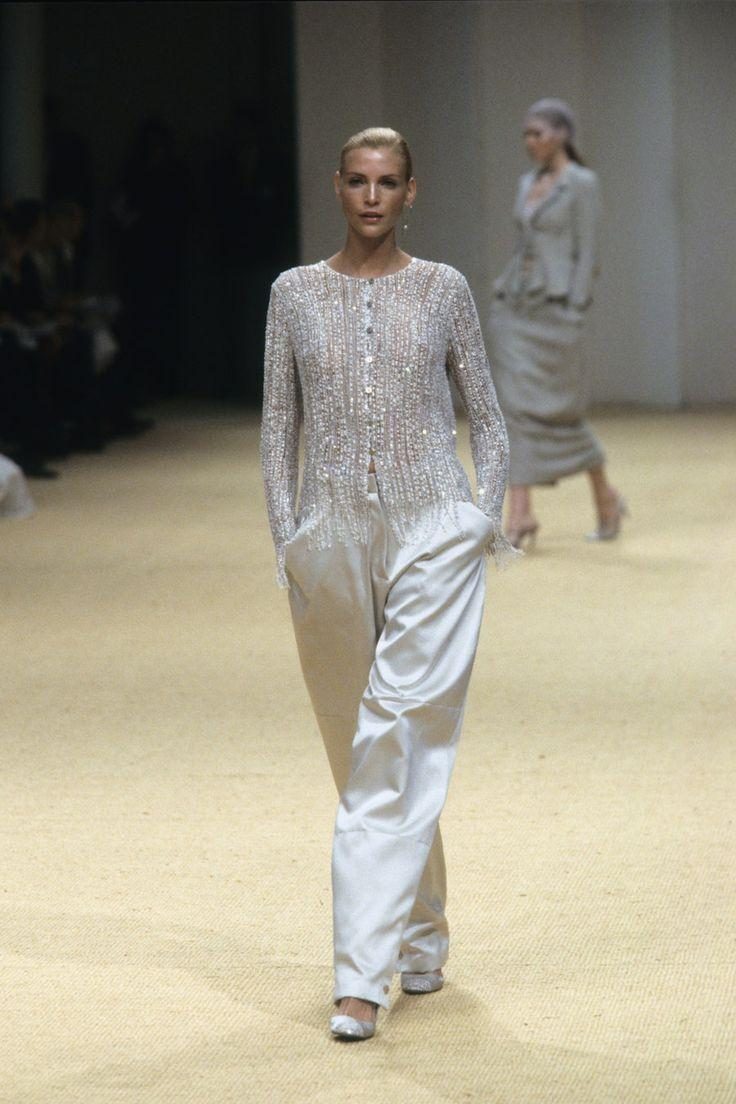
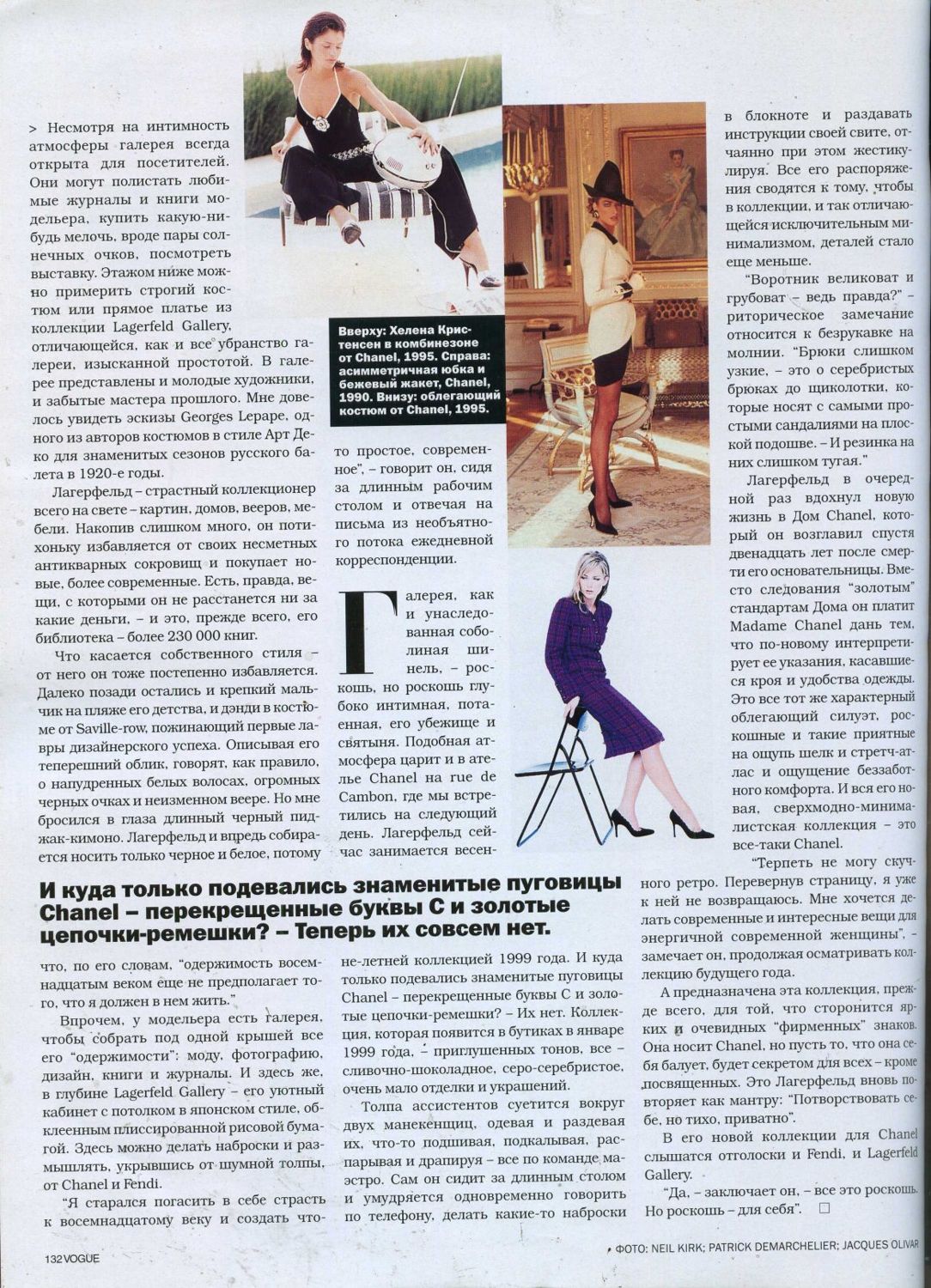
Right: Asymmetrical skirt and beige jacket, Chanel, 1990.
Below: Close-fitting Chanel suit, 1995. Vogue Russia, November 1998, p. 132
Lagerfeld repeats it once more, like a mantra:
The mantra
“Indulge yourself. But quietly, privately.”
Karl LagerfeldIn his new collection for Chanel, there are echoes of both FendiPalazzo Fendi, Rome. Photo Katalin Bán · CC BY-SA 4.0FendiThe Roman fur and leather house run by the five Fendi sisters. Karl designed for them from 1965 until his death in 2019 — the longest designer partnership in fashion. and Lagerfeld GalleryLagerfeld Gallery, 1998. Vogue Russia, November 1998Lagerfeld GalleryKarl’s own line and shop, opened in April 1998 on the rue de Seine in Paris: clothes, books, photographs and exhibitions under one roof..
“Yes,” he concludes,
“it’s all luxury.
But luxury for oneself.”
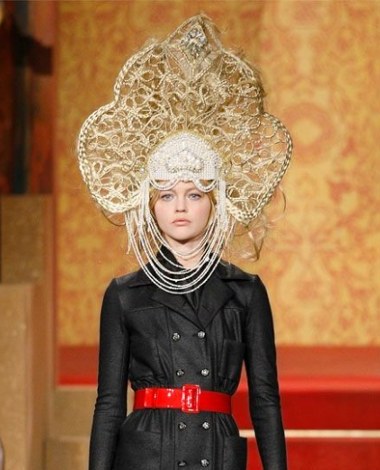
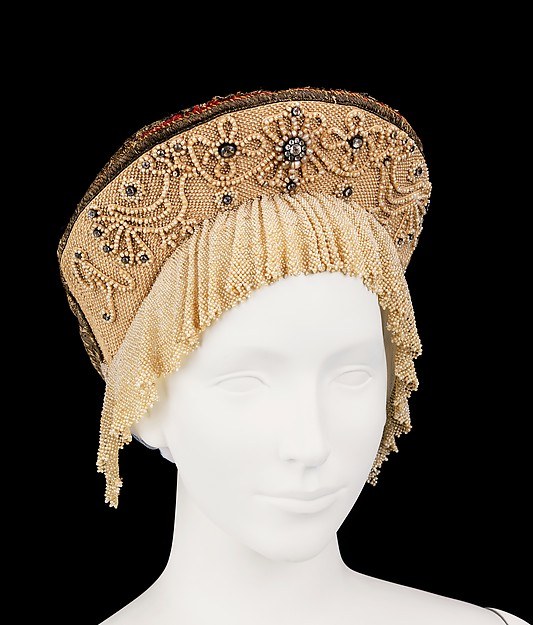 Russian headdress, 1790–1810. The Metropolitan Museum of Art · public domainKokoshnikThe tall, halo-shaped Russian headdress, worn by peasant brides and, in jewelled form, by ladies at the court of the tsars. It returned to the runway in Paris / Moscou.