


CHANEL Paris-Moscou · Métiers d’Art 2009
Lagerfeld Dresses the Avant-Garde in Sable
An essay of the Paris / Moscou hall
Gabrielle Chanel never set foot in Russia. Russia came to her instead, in the Paris of the 1920s, bringing a Romanov lover, a grand duchess who would learn to embroider, a perfumer from the court of the tsars and a composer whose music had scandalised Paris.
The Bolsheviks had confiscated their fortunes. Taste, however, had proved remarkably difficult to nationalise, and Chanel knew exactly what it was worth.
In December 2008, Karl Lagerfeld decided it was time to return the visit. His Paris-Moscou brought together the Romanovs and the revolutionaries, Fabergé and an avant-garde that once designed cotton prints for state factories and now sells for millions, the kokoshnik and the budenovka.
There was the Russia the Romanovs had lost, the Russia the Revolution had invented, and a third Russia that existed nowhere except in the imagination of Karl Lagerfeld.
I
The Tsar’s Romanovs: Rich in Everything but Money
The Revolution of 1917 produced some interesting changes of profession. Russian princes became Parisian taxi drivers, countesses became mannequins, and a grand duchess found herself in the embroidery business. Gabrielle Chanel, whose own journey through French society had taken precisely the opposite direction, was ideally placed to appreciate the irony.
Paris in the early 1920s offered an unusual encounter between people who had been born into luxury and a woman who was in the process of redefining it. The Russians had generations of experience in the art of living beautifully. Chanel had discovered that beauty could be a business.
Her lover, Grand Duke Dmitri Pavlovich, came with impeccable credentials and an adventurous biography. A grandson of Alexander II, first cousin of Nicholas II and one of the men involved in the assassination of Rasputin, he had lost his country and acquired a French couturière. Fashion would ultimately owe more to his wardrobe than to his political career.
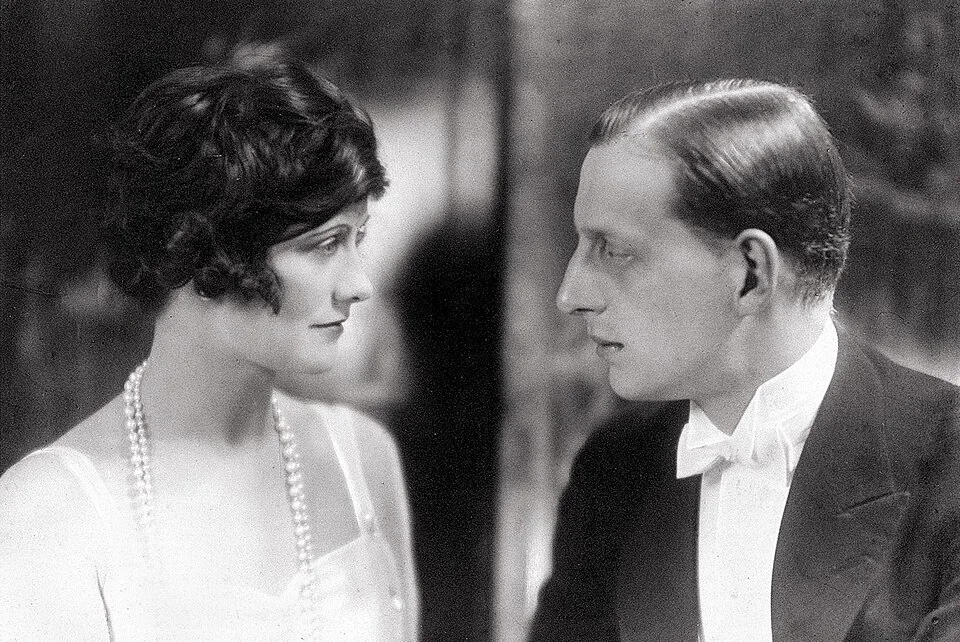
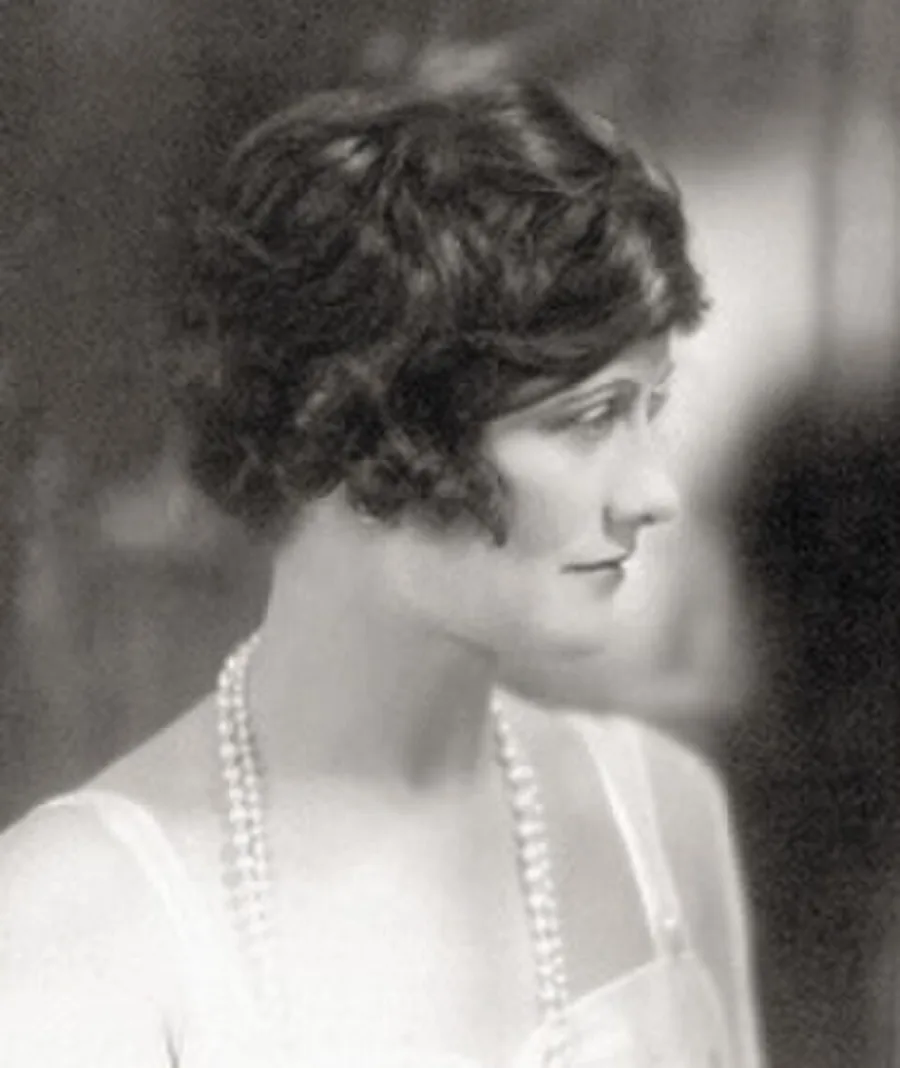
The Russian tunic, the fur-lined pelisse and the embroidered rubashka entered the vocabulary of Chanel, as did her growing taste for Byzantine jewellery and the richness of Russian court ornament. Look at the Chanel silhouettes of 1922, with their loosely belted tunics and long ropes of pearls, and the presence of Russia is unmistakable. Yet there is nothing nostalgic about them. Gabrielle was dressing the future with fragments of somebody else’s past.
Dmitri also introduced her to Ernest Beaux, the Moscow-born perfumer who had made scents for the Russian court. In 1921 came No. 5, followed a few years later by Cuir de Russie, with its smoky evocation of Russian leather. For a country Gabrielle had never visited, Russia had made an astonishing impression on her senses.
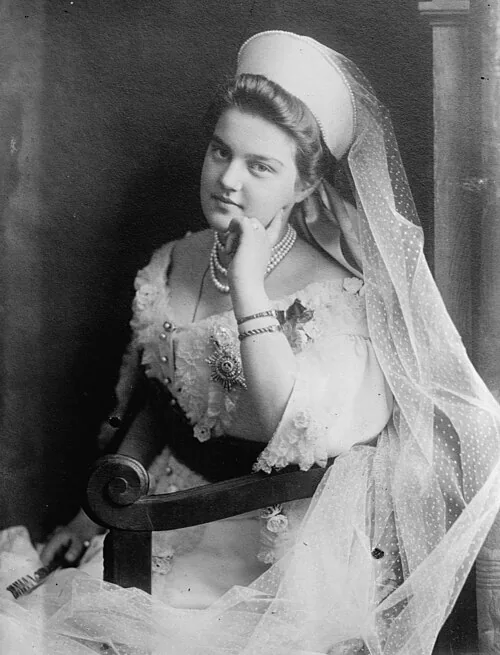
Then there was Dmitri’s sister, Grand Duchess Maria Pavlovna. Her encounter with Mademoiselle would lead to the creation of Kitmir, the Parisian embroidery atelier whose history reads like an improbable novel about money, pride and survival. The Grand Duchess discovered that negotiating with Chanel required talents for which her Romanov upbringing had scarcely prepared her.
And if the Romanovs introduced Gabrielle to one Russia, the Ballets Russes introduced her to another.
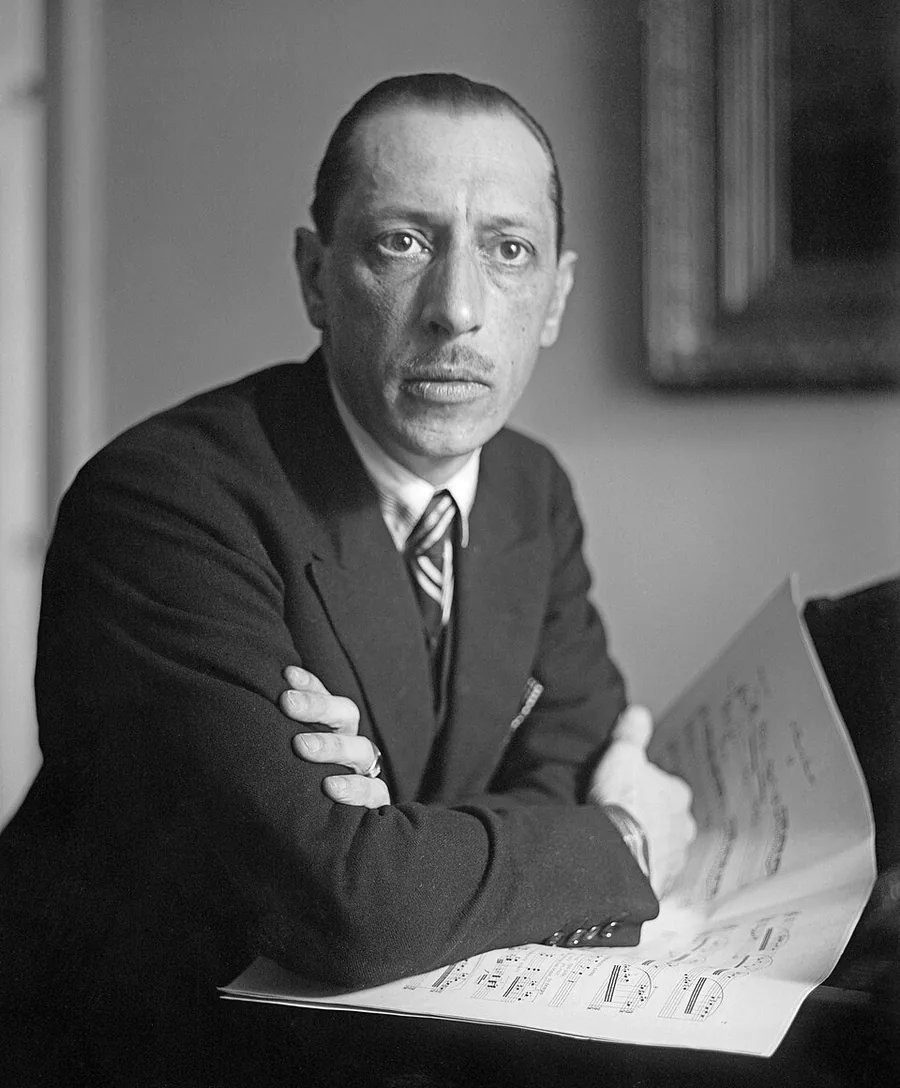
Igor Stravinsky, whose The Rite of Spring had scandalised Paris in 1913, found hospitality for himself and his family at Chanel’s villa Bel Respiro. She financed the revival of the ballet and, according to her own account, became his lover. Through Serge Diaghilev, she entered an artistic circle in which painters designed for the theatre, composers overturned musical conventions and a couturière could change the way a dancer moved.
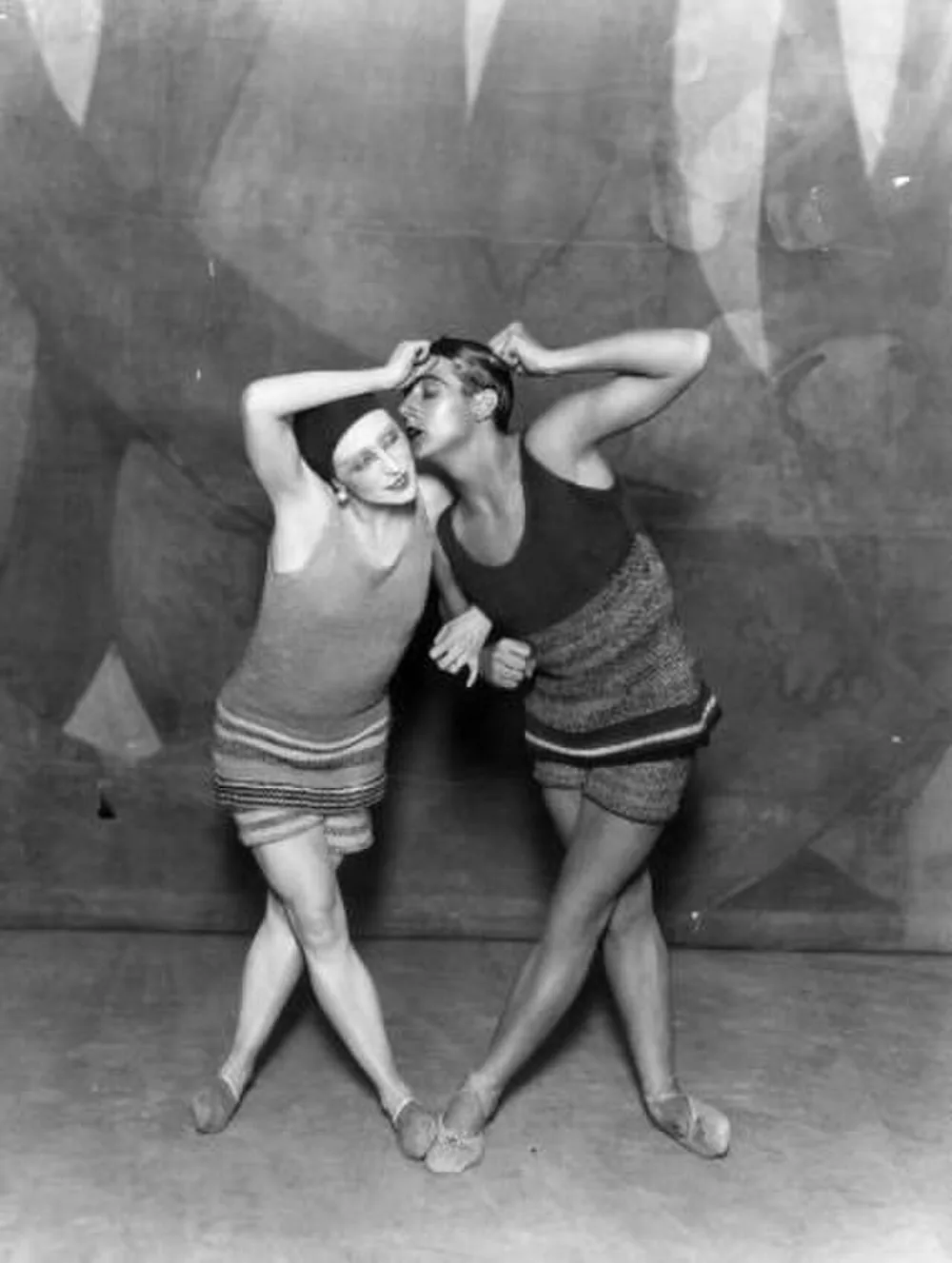
In 1924, she designed the costumes for Diaghilev’s Le Train Bleu, with a scenario by Jean Cocteau and a curtain based on a painting by Picasso. The subject was not Russian history but the modern pleasures of the French Riviera: swimming, tennis, sunbathing and beautiful people with time on their hands. It took a Russian ballet company to put Chanel’s vision of modern French life on stage.
Chanel’s Russian years
- 1913The Rite of Spring causes a riot in Paris
- 1917The Revolution. The Romanovs lose Russia
- 1920Chanel pays for the revival of The Rite; Stravinsky’s family at Bel Respiro
- 1920–21Grand Duke Dmitri
- 1921No. 5. Kitmir opens its workroom
- 1922Belted Russian tunics, long ropes of pearls
- 1924Le Train Bleu
The Russia that entered Gabrielle’s life existed in the memories of her lovers, the hands of her embroiderers, the music of her friends and the chemistry of her perfumer.
It had a Parisian address.
II
Le Ranelagh: Russia as Imagined by Lagerfeld
More than eight decades later, Lagerfeld approached the Russian chapter of Chanel’s biography with the instincts of a film director. In fact, he decided to become one.
On 3 December 2008, the guests of Paris-Moscou took their seats at the Théâtre Le Ranelagh, a little nineteenth-century theatre of carved wood and red velvet in the sixteenth arrondissement of Paris. The lights went down, and instead of a fashion show, they found themselves watching a silent film.
CHANEL presents
Coco 1913 — Chanel 1923
a silent film by Karl Lagerfeld
- 10 minutes
- 2 days of shooting
- 1 grand duke
- B/W
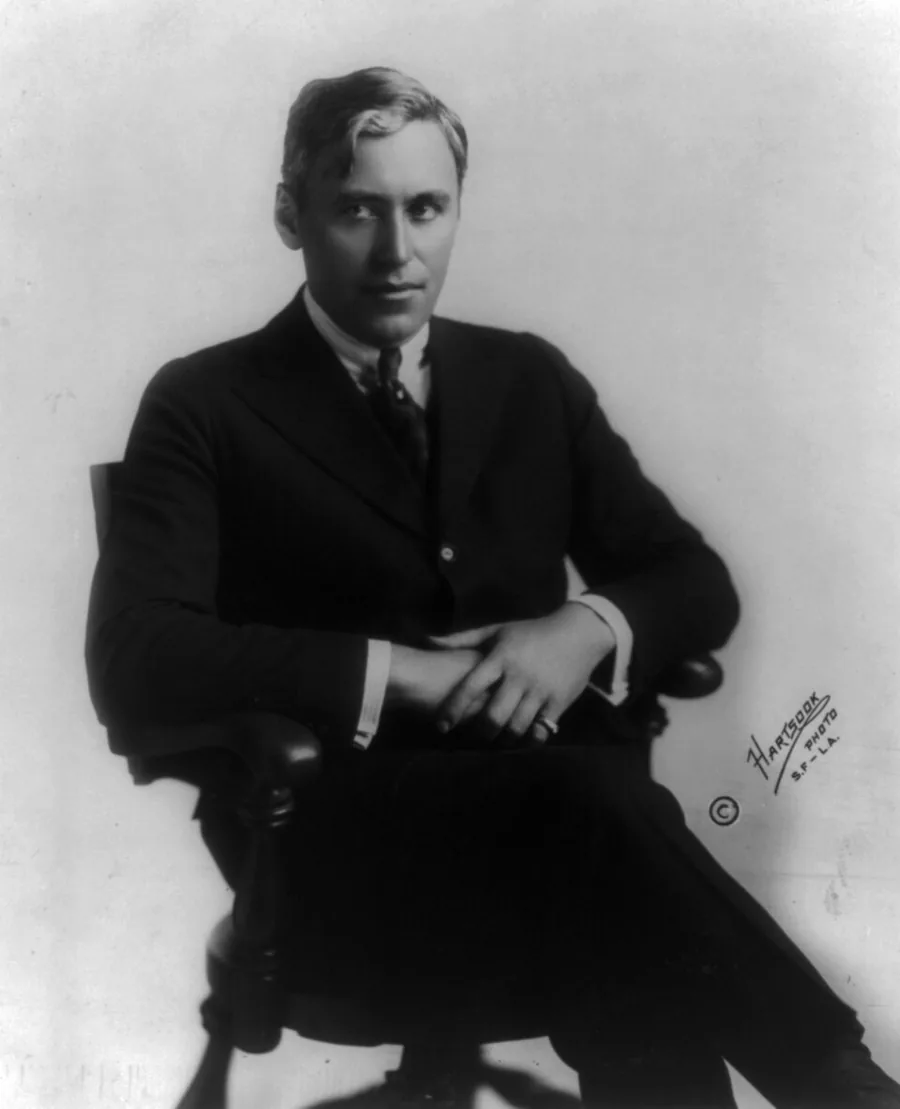
Coco 1913 – Chanel 1923 was Lagerfeld’s directorial debut, ten minutes in black and white, filmed in two days and inspired by the comedies of Mack Sennett. Edita Vilkeviciute played Gabrielle Chanel, Brad Kroenig became Grand Duke Dmitri, and the women working in the Chanel atelier were played by actual Chanel seamstresses.
By then, Mademoiselle’s biography was being treated with all the solemnity of a national monument. Lagerfeld seemed to remember what her more reverential biographers occasionally forgot: she had led an extremely entertaining life.
Silent comedy suited a woman whose biography contained so many episodes that might have embarrassed the author of a respectable novel. Lagerfeld could exaggerate a gesture, invent an encounter or compress years into a few minutes. He had no interest in turning the rue Cambon into a historical reconstruction.
Gabrielle had known Russia through the people who remembered it. Lagerfeld knew their Russia through the memories she had left behind. By the time he began making clothes, the country had already passed through several imaginations.
When the film ended, the models came down the theatre aisle as though they had stepped straight out of the screen. The audience had already met the Grand Duke. Now it could see what had become of his Russia in the hands of Lagerfeld.
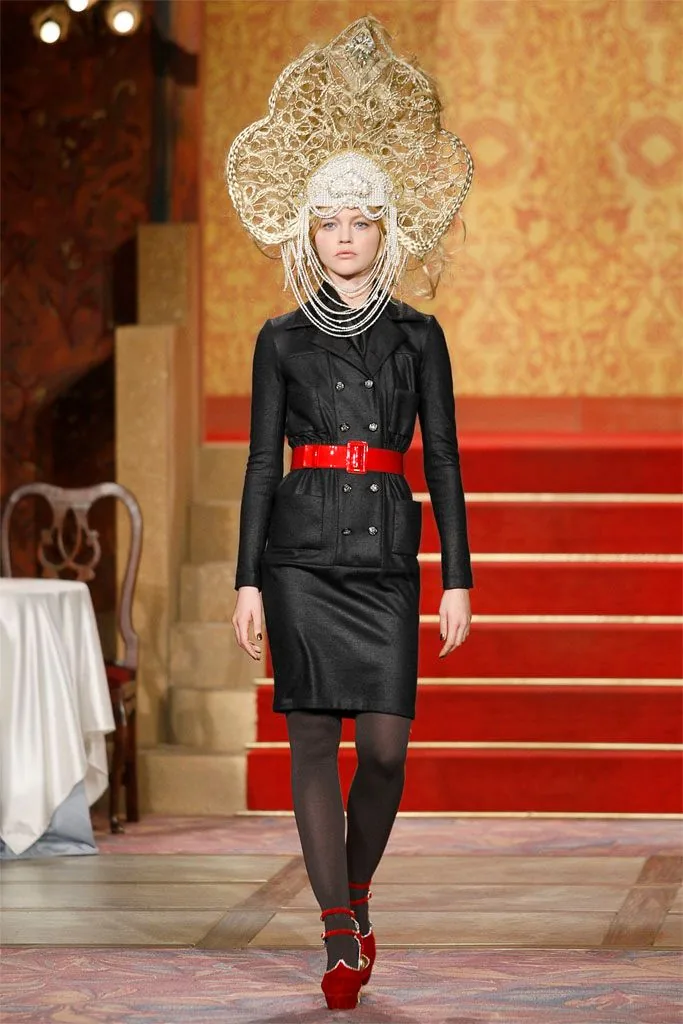
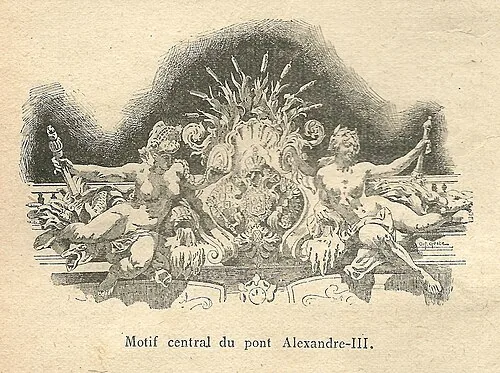
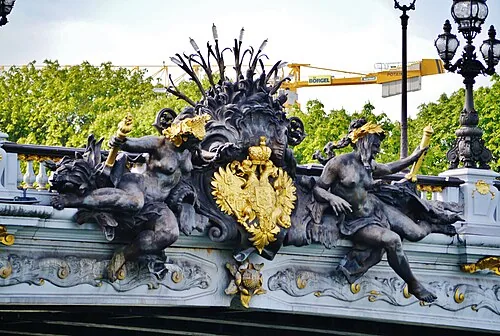
For the photographs of Paris-Moscou, he found another piece of Russia in Paris: the Pont Alexandre III. Inaugurated in 1900, the bridge celebrated Franco-Russian friendship. At the centre of its arch, on opposite faces, the nymphs of the Seine and the Neva face the river in hammered copper.
Twenty years before Gabrielle met Dmitri, Paris had already built a monument to the friendship between their two countries. Lagerfeld could hardly have wished for a better setting for a Russia of his own invention.
And that Russia came with all the insignia of power.
III
Double-Headed Eagles and Other Matters of State
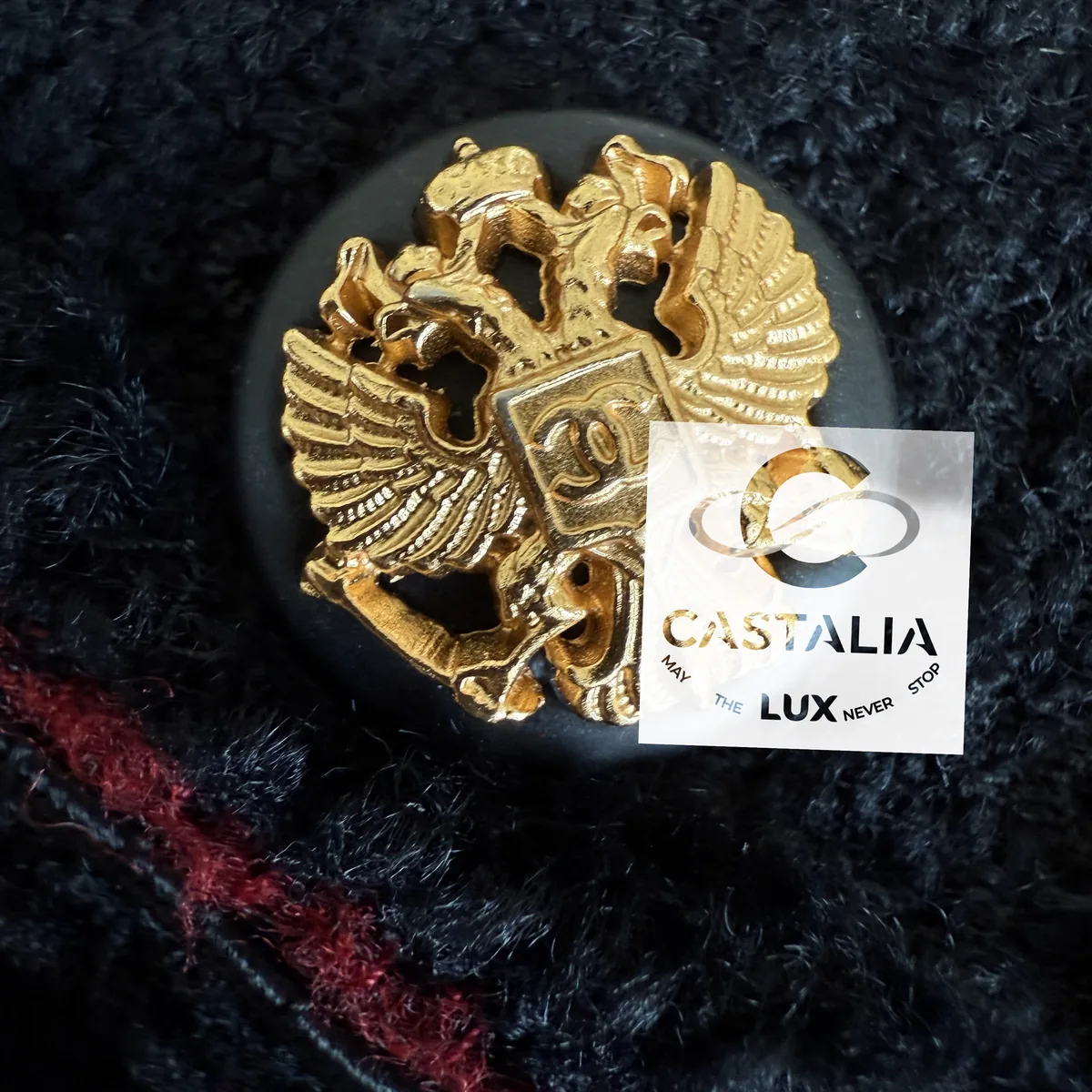
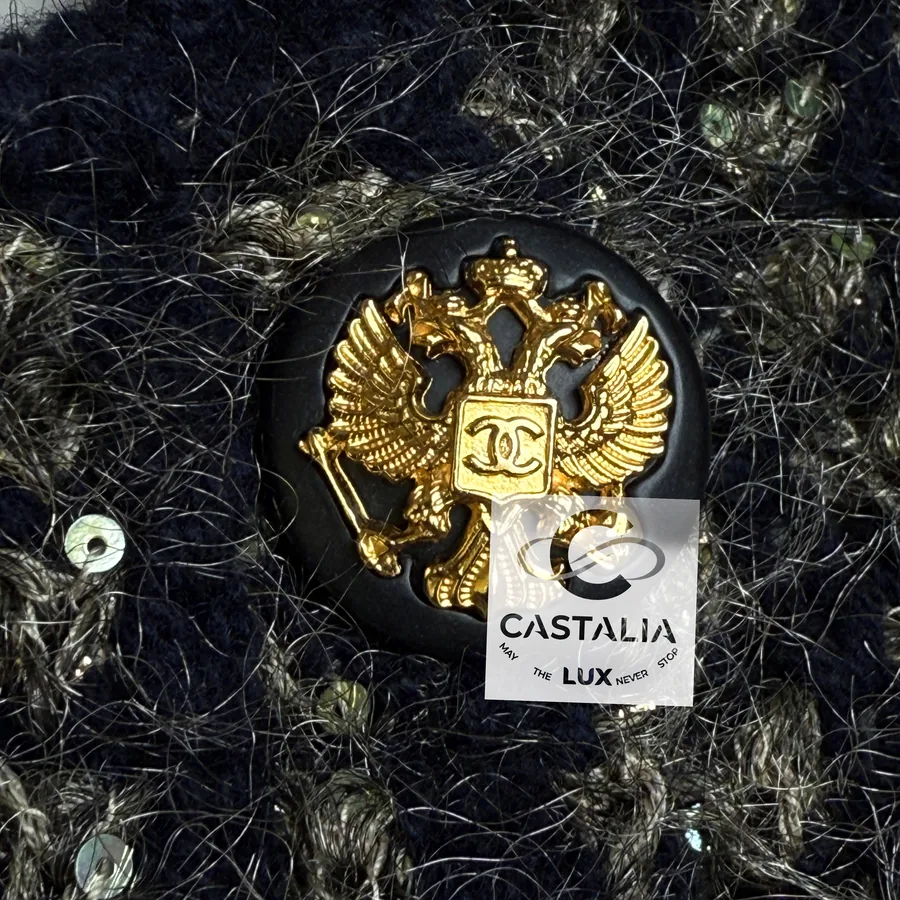
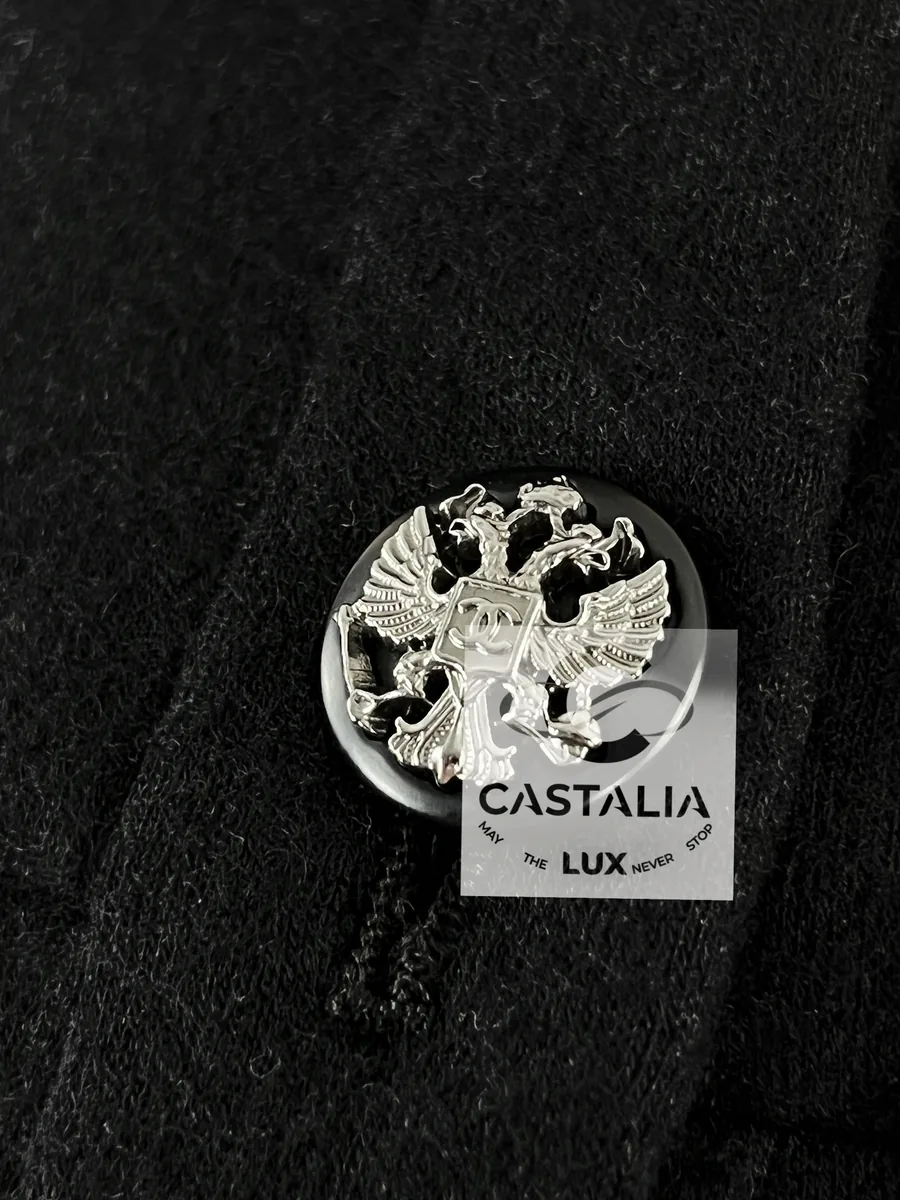
Few buttons come with a history quite as eventful as those of Paris-Moscou.
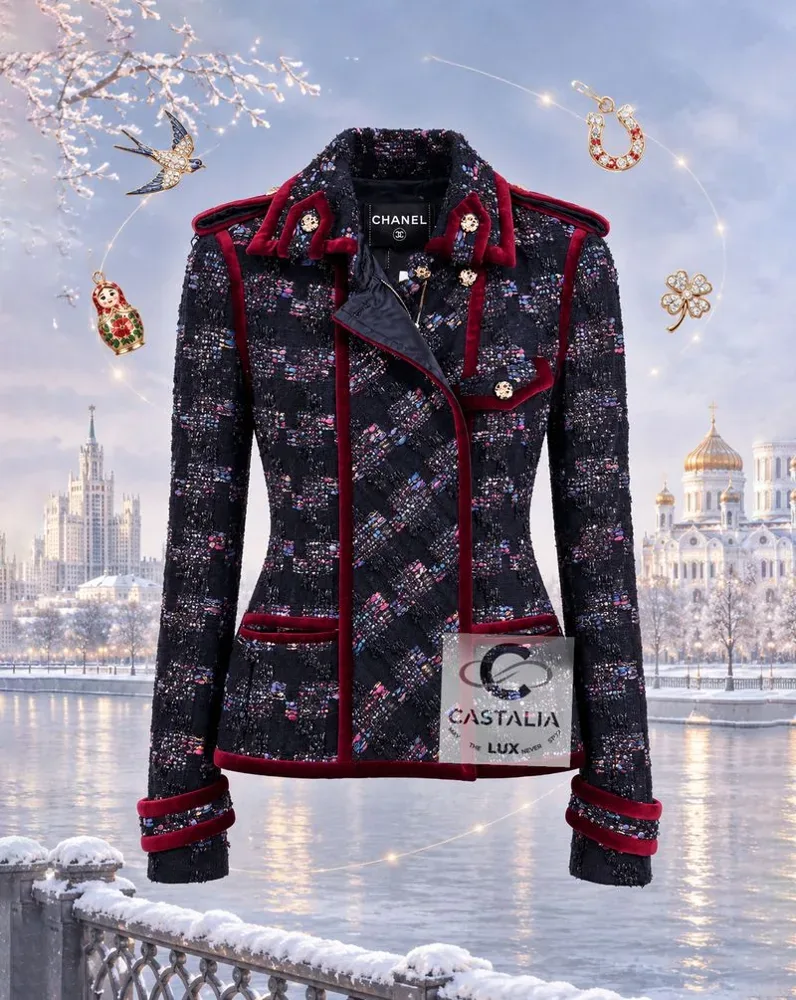
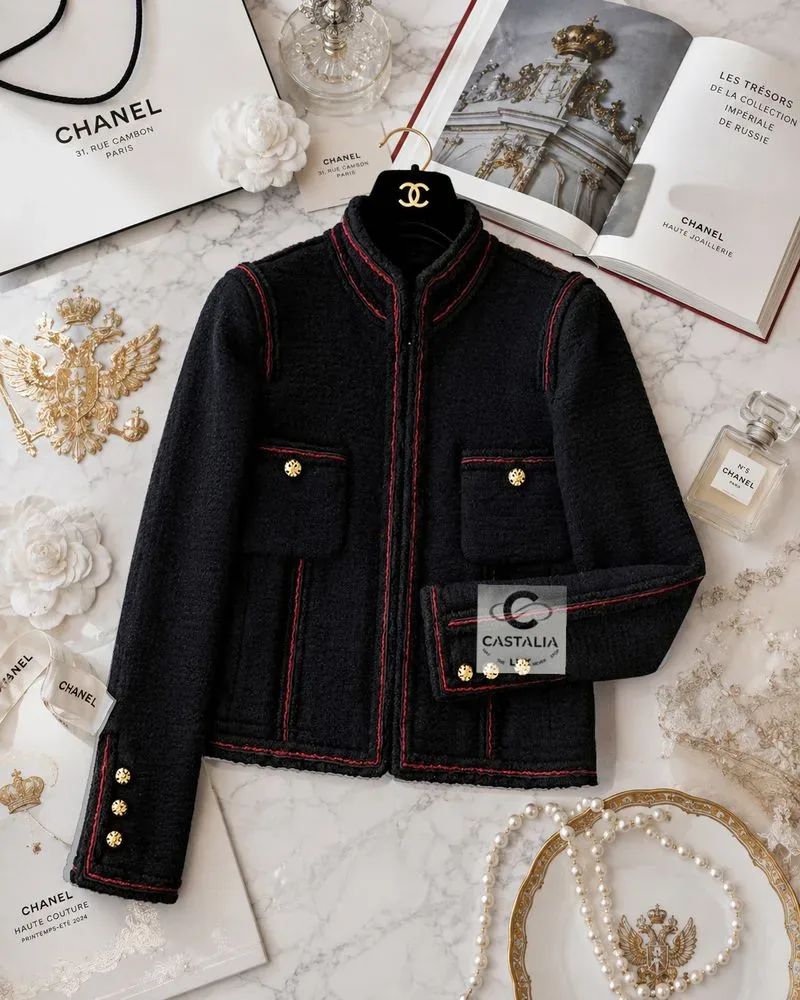
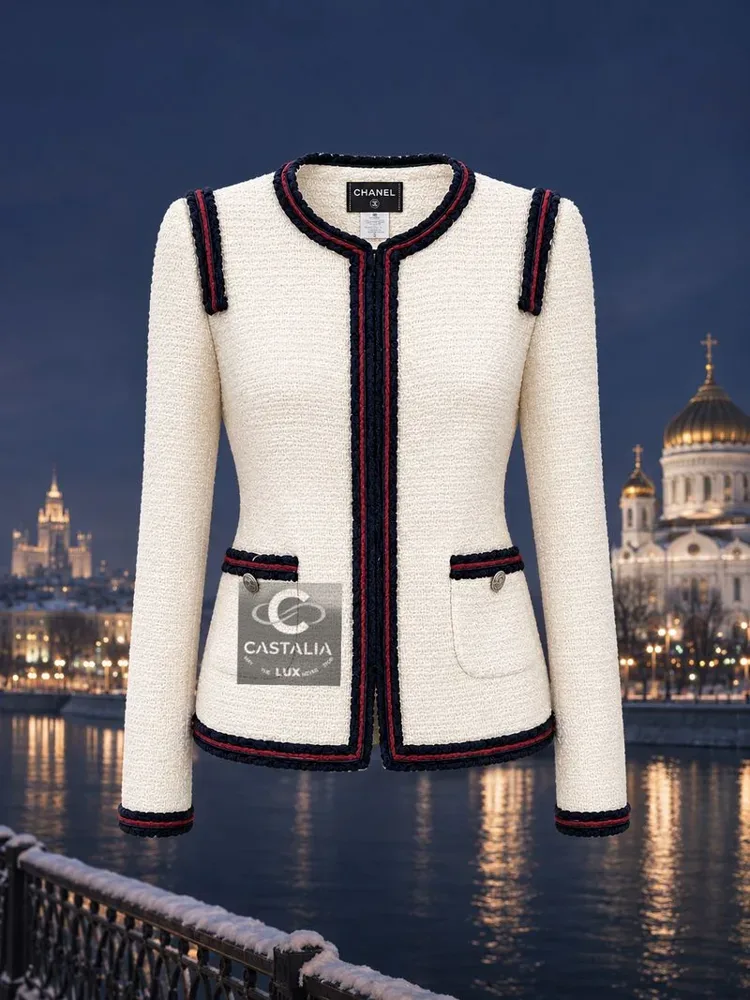
Against the deep red and black tweed of a Chanel jacket, the gilded double-headed eagle shone with all the splendour of the Romanov coat of arms.
For five centuries the eagle had lived on seals, banners and palace gates. Lagerfeld gave it a far more intimate address: a button, worn close to the heart.
The eagle also invites a journey further back in time. Long before the Romanovs, the lands of Rus’ had received Orthodox Christianity and much of their sacred art from Byzantium. After the fall of Constantinople in 1453, the idea of Moscow as the Third Rome began to take shape.
Lagerfeld travelled through this cultural history in reverse. Paris-Moscou came in 2009, Paris-Byzance in 2011, as though Moscow had made him curious about Constantinople.
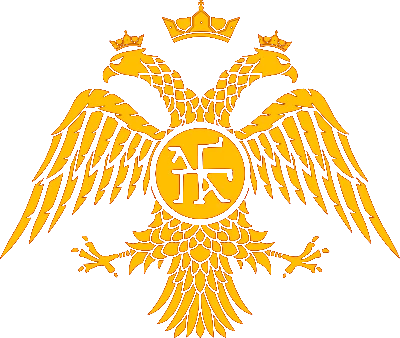 ByzantiumThe eagle of the Palaiologoi, the last imperial dynasty of Constantinople, 15th century
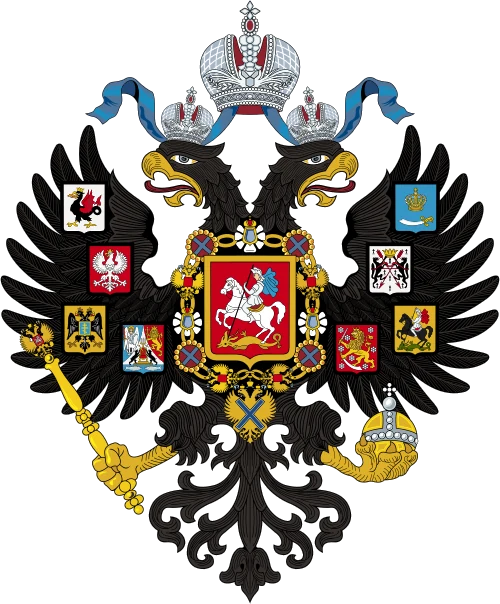 The Russian EmpireBlack on gold, three crowns, sceptre and orb. Lesser coat of arms, 1883
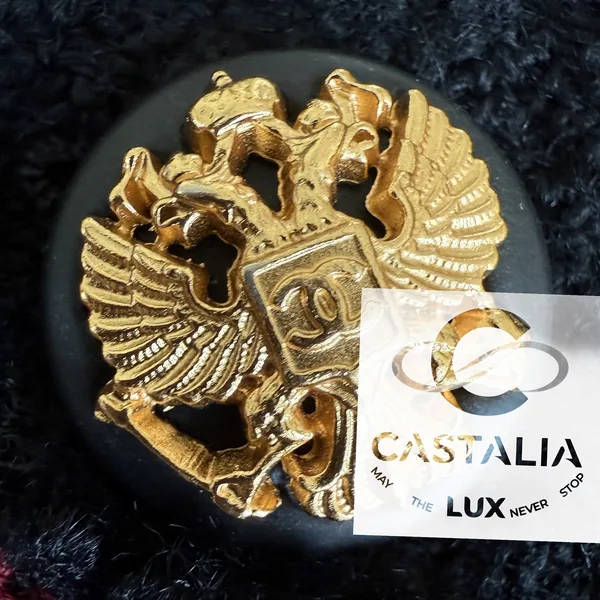 Paris-MoscouGilded, with the CC on its breast. The button, 2009
In both collections, gold was more than a colour. In Moscow, as in Constantinople, it was the colour of icons and cupolas, of light caught and held for centuries. Lagerfeld knew that the house had always worn gold with ease: Gabrielle piled ropes of it over a plain sweater as though it were the most natural thing in the world.
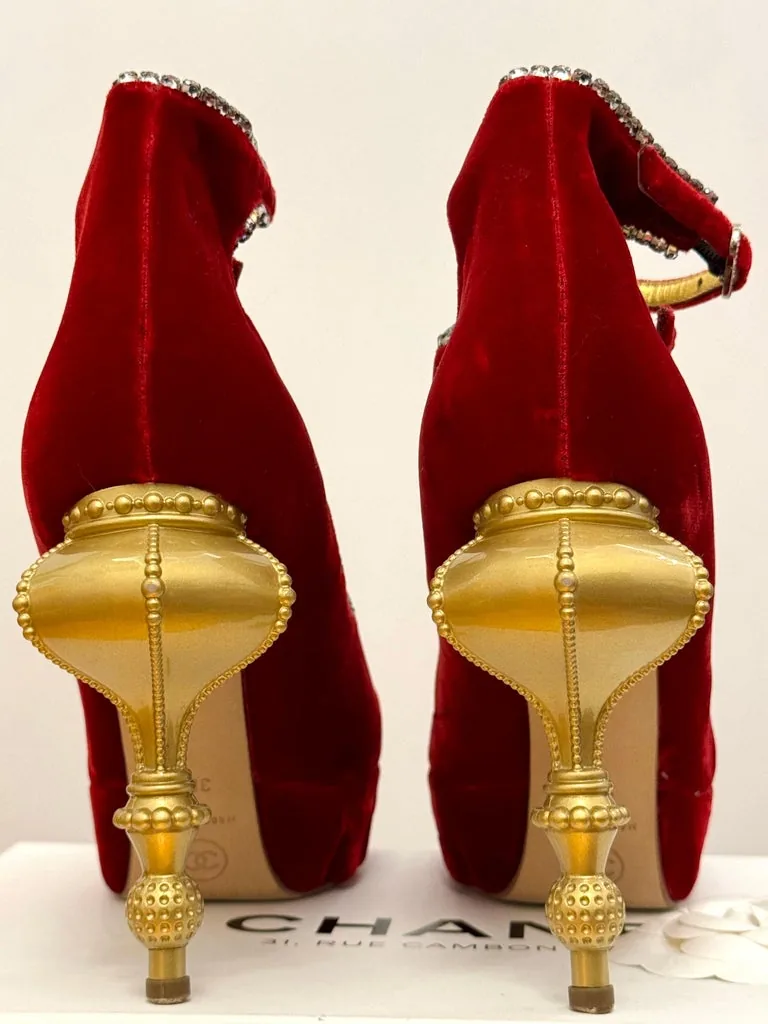
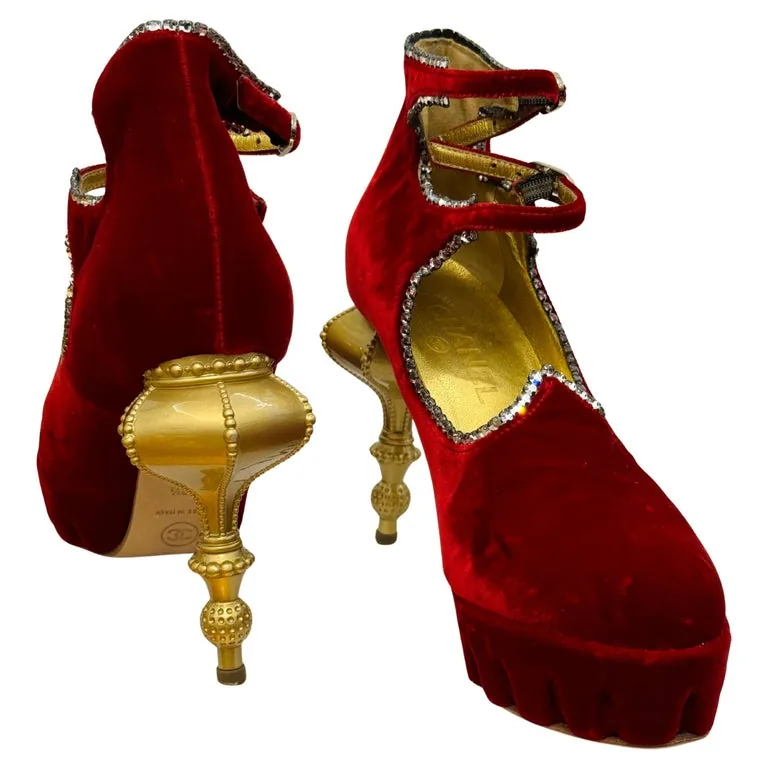
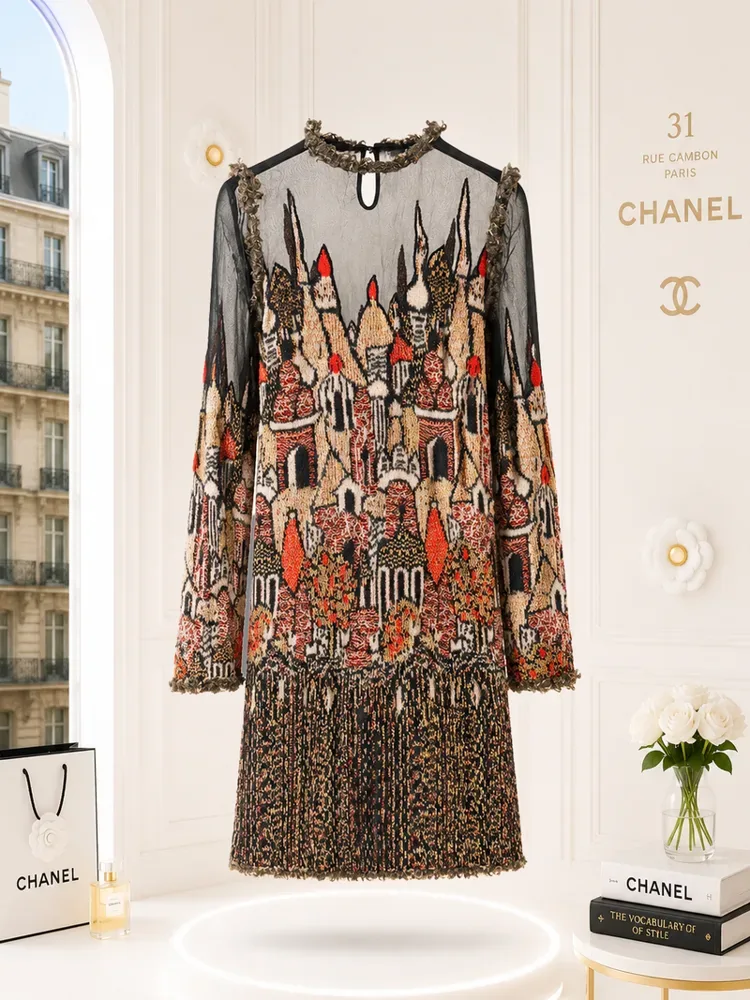
The domes of St Basil’s Cathedral appeared in embroidery on jackets and coats, but it was on the evening shoes that the reference became pure Lagerfeld: gilded domes formed the heels. An architectural silhouette recognisable across the world had been reduced to a few centimetres of gold.
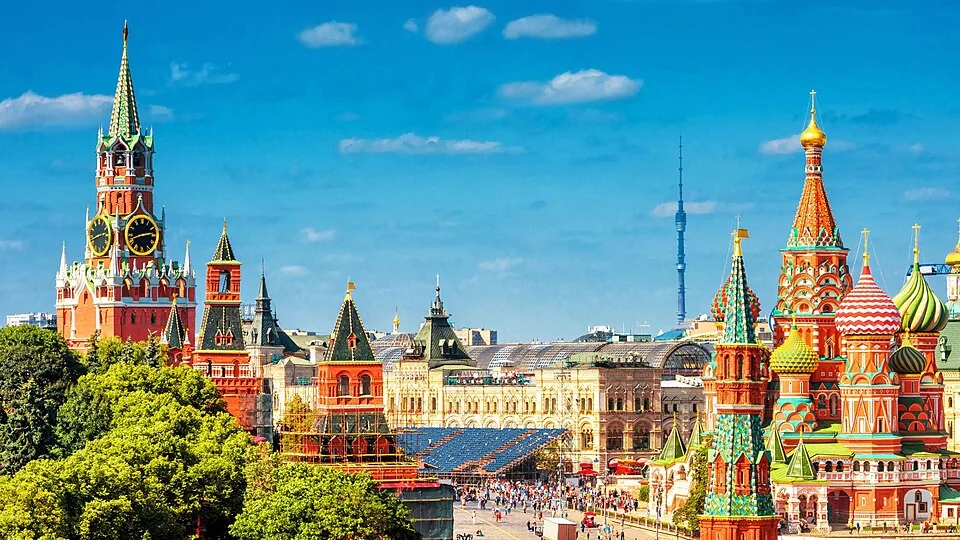
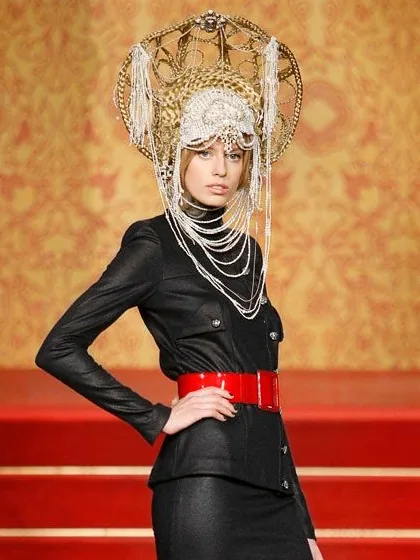
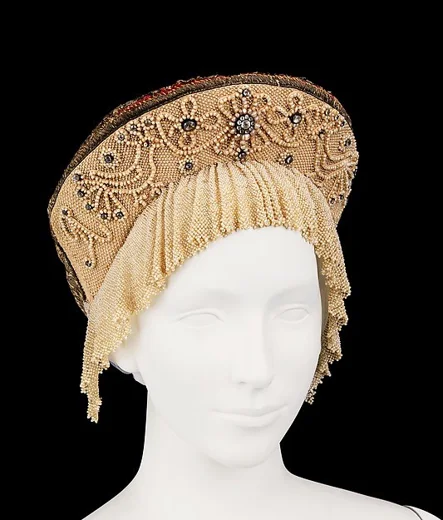
Above the models’ heads, pearl-covered kokoshniks evoked the halos of Orthodox icons. There was an unexpected affinity between Russian sacred art and Chanel’s taste for extravagant jewellery. Both understood what light could do to gold and pearls.
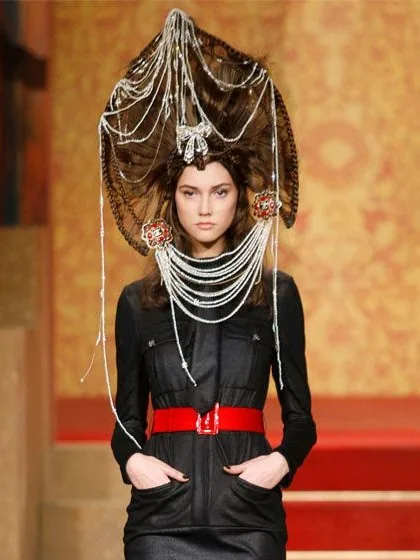
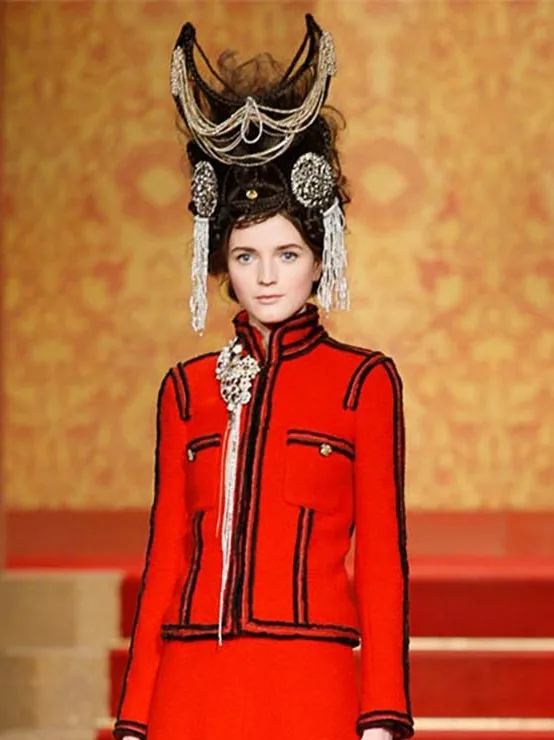
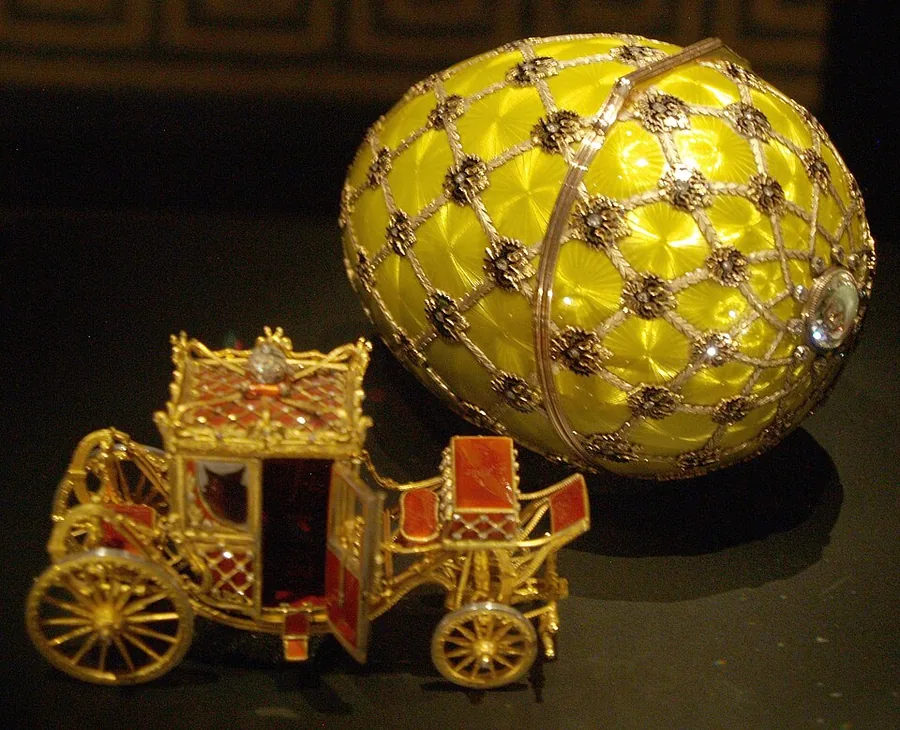
And what would the Russian court be without Fabergé? The jewelled Easter egg, that extravagant solution to the annual problem of what to give an empress, became an evening bag. Even the famously practical Chanel 2.55 appeared to have received an invitation to a ball at the Winter Palace.
The Romanovs had understood the importance of a beautiful image, and theirs has outlived the dynasty by more than a century. The eagle alone has survived revolutions, changes of government and some spectacular changes of wardrobe.
Yet among all these treasures of the Russian court, Lagerfeld reserved some of his greatest affection for an object that had never belonged to it.
Eagles in the hall

IV
Matryoshka: A Lady Never Reveals Everything
For an object so synonymous with Russia, the matryoshka is a surprisingly recent invention. Born in the 1890s, the little wooden doll made her international debut at the Exposition Universelle in Paris in 1900. More than a century before Lagerfeld turned her into a Chanel minaudière, she had already charmed Paris.
A matryoshka rewards curiosity. Open her and there is another figure inside. Open that one and the story continues. Even when you know perfectly well what you are going to find, there is an almost childish pleasure in discovering it.
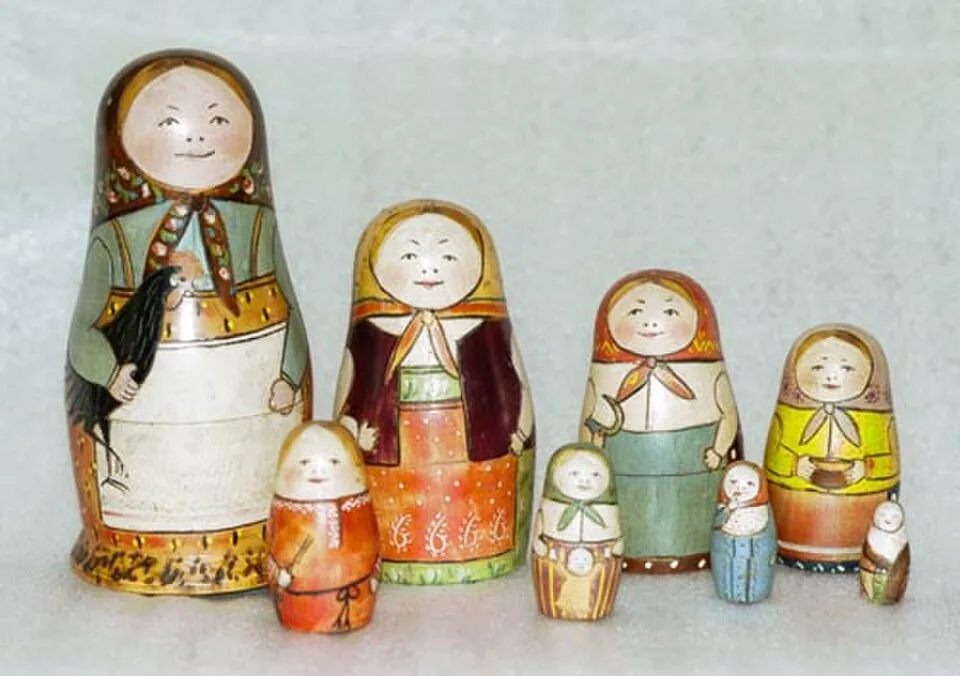
The genius of the matryoshka lies in her refusal to satisfy curiosity all at once.
Lagerfeld’s matryoshka minaudière retained the familiar silhouette of the Russian doll, reimagined in black lucite with brushed-gold hardware, a CC turn-lock and a leather-threaded chain.
There was just about enough room inside for a lipstick and a secret.
At around six thousand dollars in 2009, she had acquired expensive habits without appreciably altering her appearance. The matryoshka minaudière would become one of the most coveted objects in the Chanel archive.
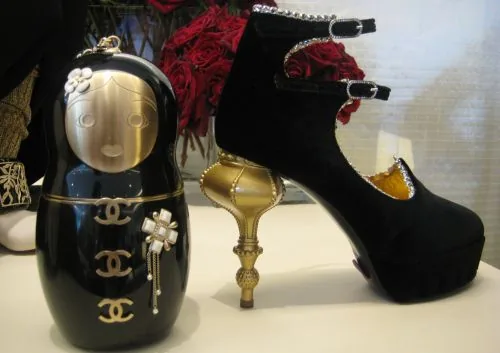
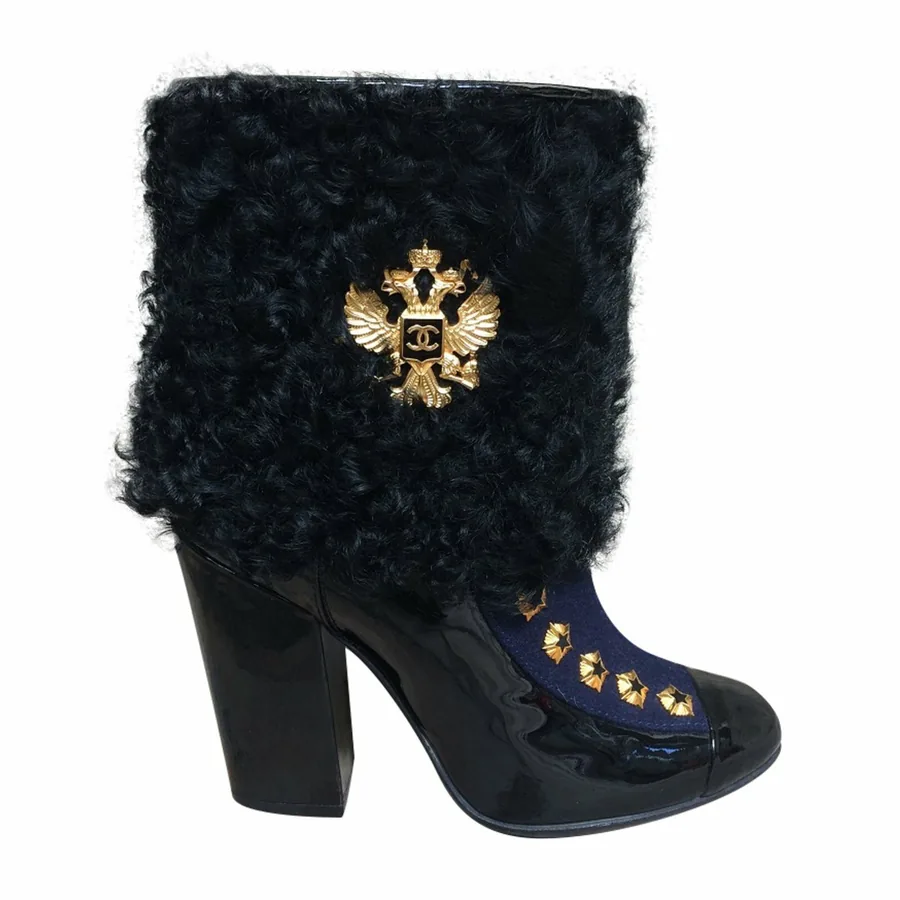
The Fabergé egg and the wooden doll came from opposite ends of Russian society, yet Lagerfeld found them equally desirable. One had been made for a tsarina, the other for a child. Both held out the promise of a surprise inside.
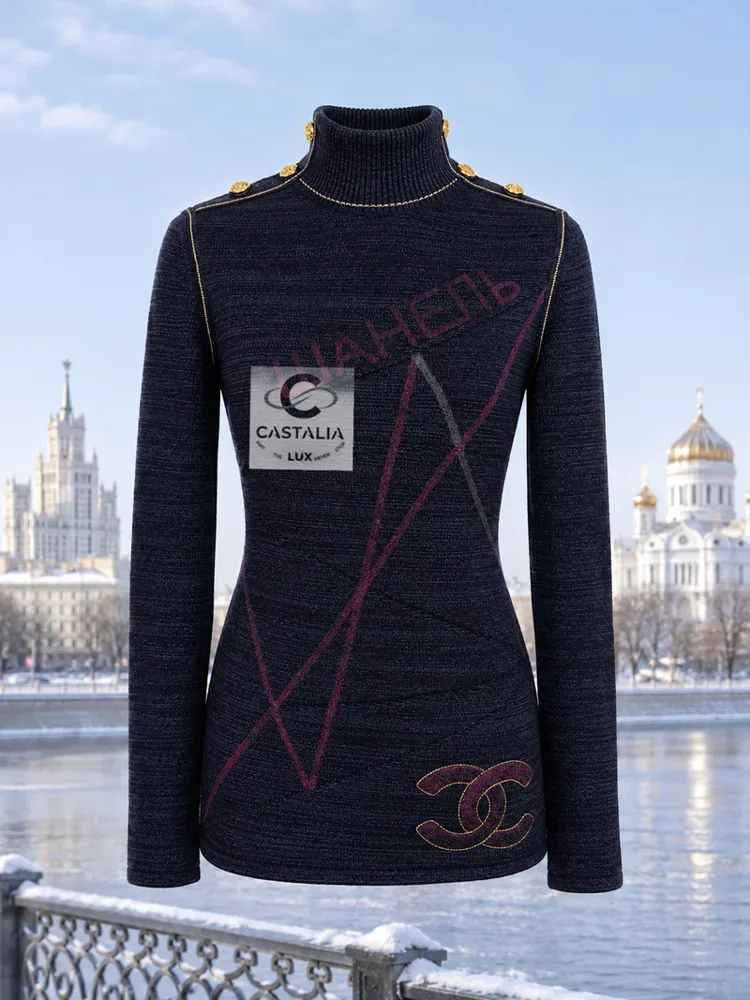
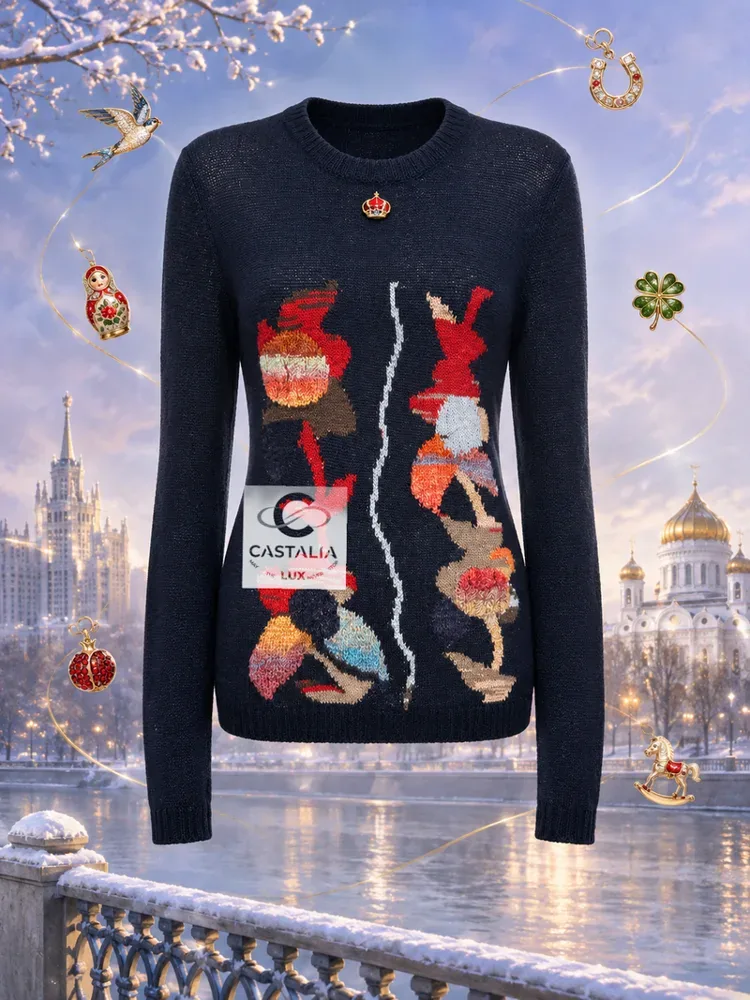
The sarafan, the babushka scarf, the low-belted tunic and Cossack boots brought this other Russia into the collection. A pullover even spelled CHANEL in Cyrillic, as though Mademoiselle had quietly acquired an address on the Arbat.
Gabrielle’s own Russian period had already demonstrated how naturally village embroidery could coexist with pearls and expensive fabrics. The distance between the wardrobe of a peasant and that of a Parisian woman had never been quite as great as their respective fortunes might suggest.
Lagerfeld went a little further. If a Russian doll and a Fabergé egg could coexist in the same jewellery cabinet, why should the Revolution and the Romanovs be kept apart?
V
The Russian Avant-Garde: The Art of the Revolution
Having dressed the Romanovs, Lagerfeld proceeded to dress the people who had overthrown them.
It is difficult to imagine either party approving of the arrangement.
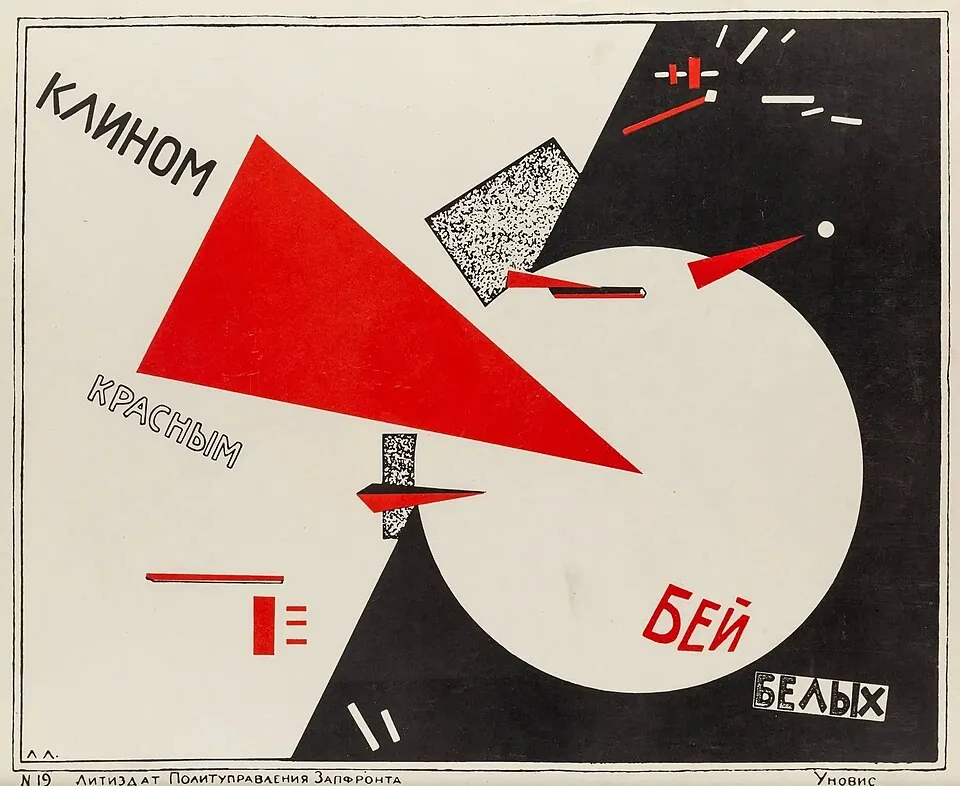
The mood changed. Against the gold and ornament of the Russian court appeared severe black silhouettes and sudden collisions of colour. The visual language was that of the Russian avant-garde, whose artists had ambitions far beyond producing interesting pictures.
They wanted to change the way people lived. They imagined a world in which beauty would no longer be the privilege of the wealthy, in which art could be found in a factory, on a street poster or in the pattern of an ordinary cotton dress.
Constructivism gave that ambition a visual language. Geometry had a new energy; colour seemed to move. The artists who had abandoned the conventions of painting were also imagining new houses, new clothes and, ultimately, a new society.
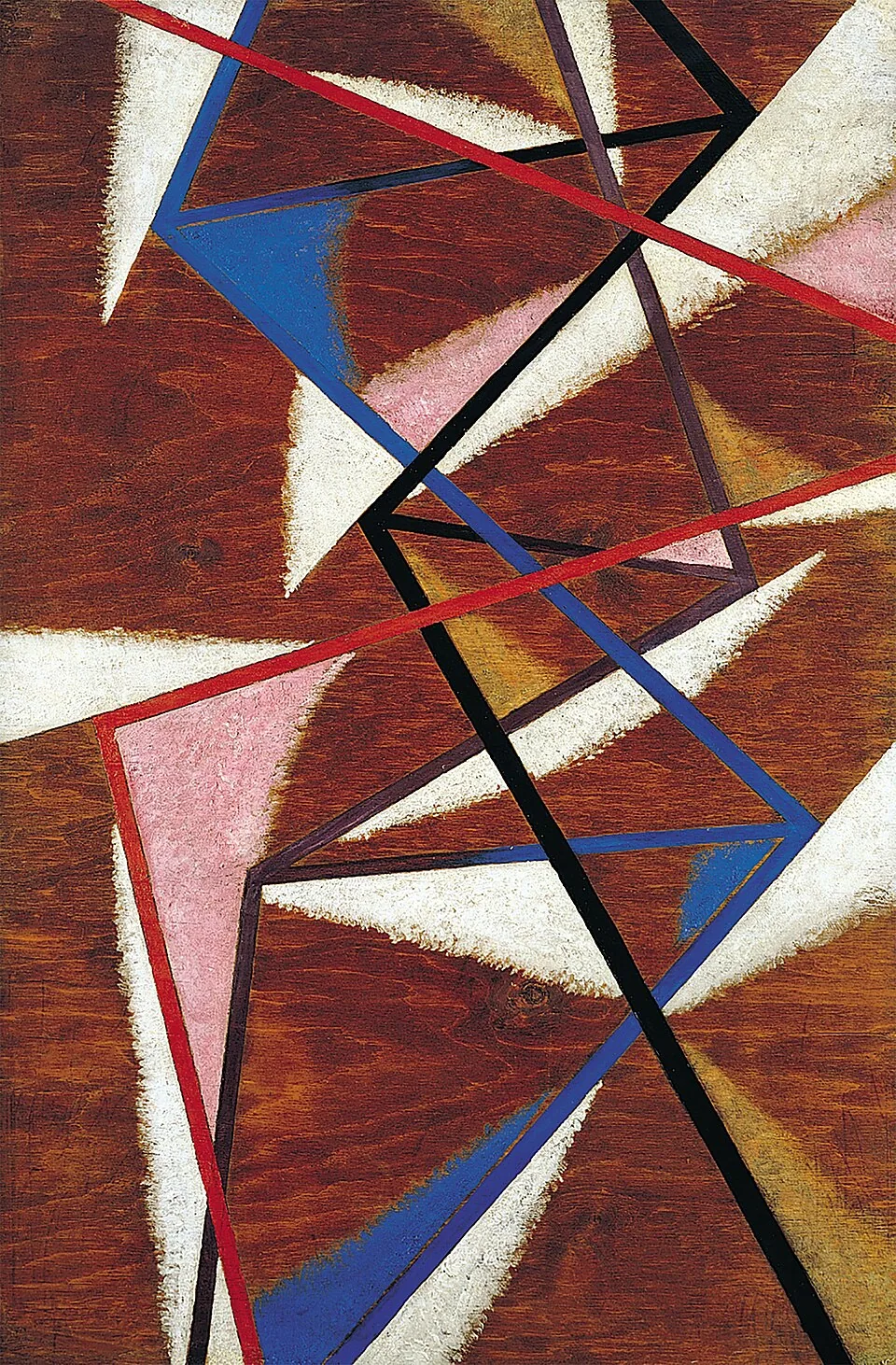
Among them was Liubov Popova. In her series Painterly Architectonics, shapes overlap and colours interrupt one another, creating the impression that the whole composition might shift before your eyes. By the early 1920s, she had begun applying her ideas to textiles intended for everyday wear.
The timing of Lagerfeld’s encounter with her work was fortunate. While Paris-Moscou was taking shape, works from the Costakis collection of Russian avant-garde art were being exhibited at the Musée Maillol in Paris.
One of Popova’s compositions inspired a black taffeta evening dress. Maison Lesage translated the geometry of her painting into embroidery, preserving its angles, its tension and its startling combinations of colour.
Virginie Viard, then Lagerfeld’s closest collaborator in the studio, saw in the dress the two faces of Moscow: the magnificence of its historical inheritance and the audacity of its artistic revolution.
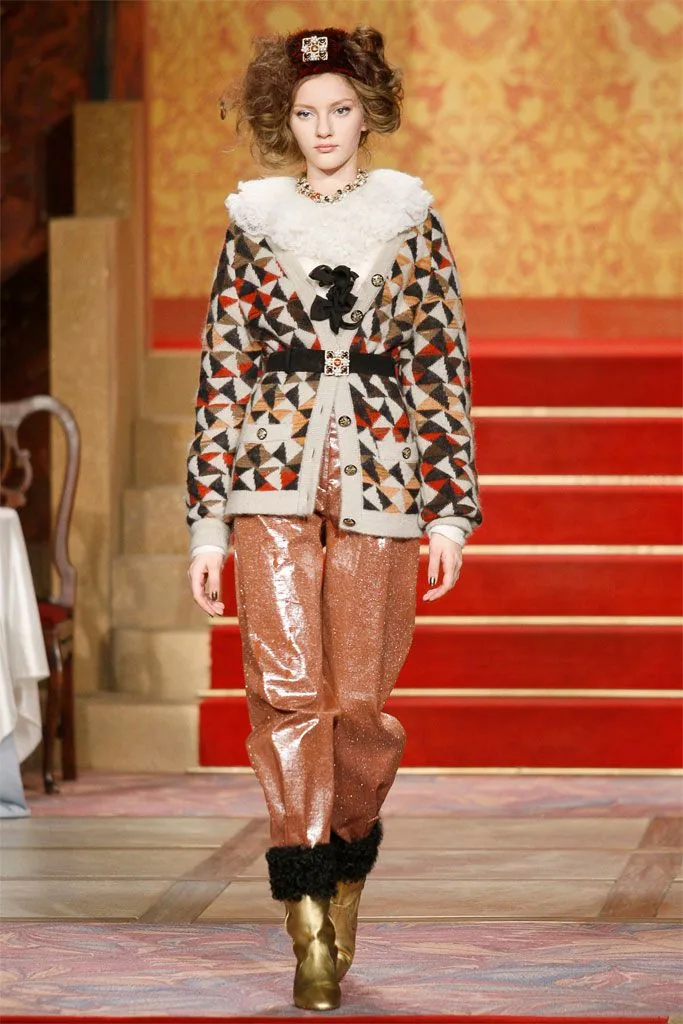
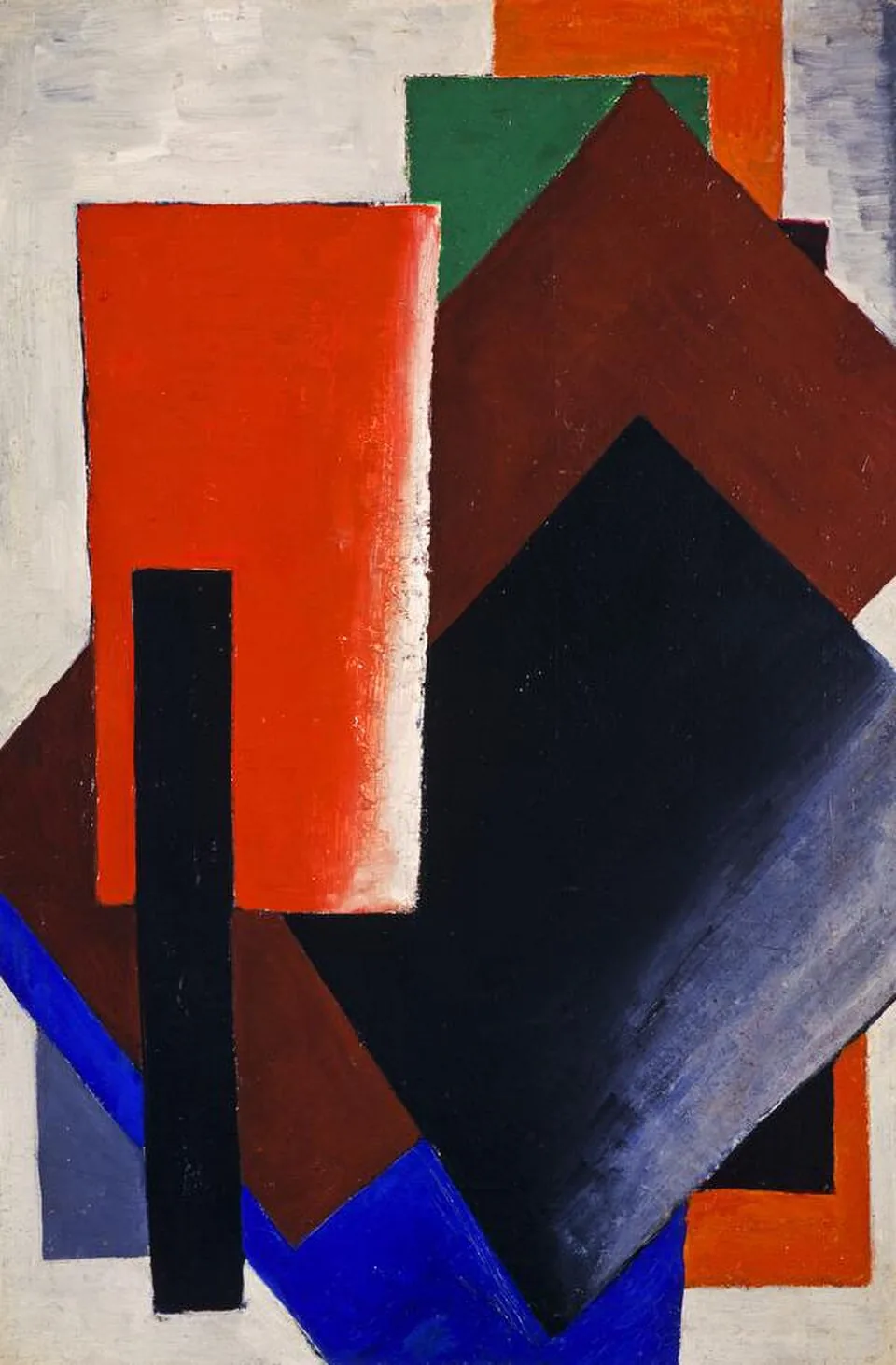 Popova, c. 1918Paris-Moscou, 2009
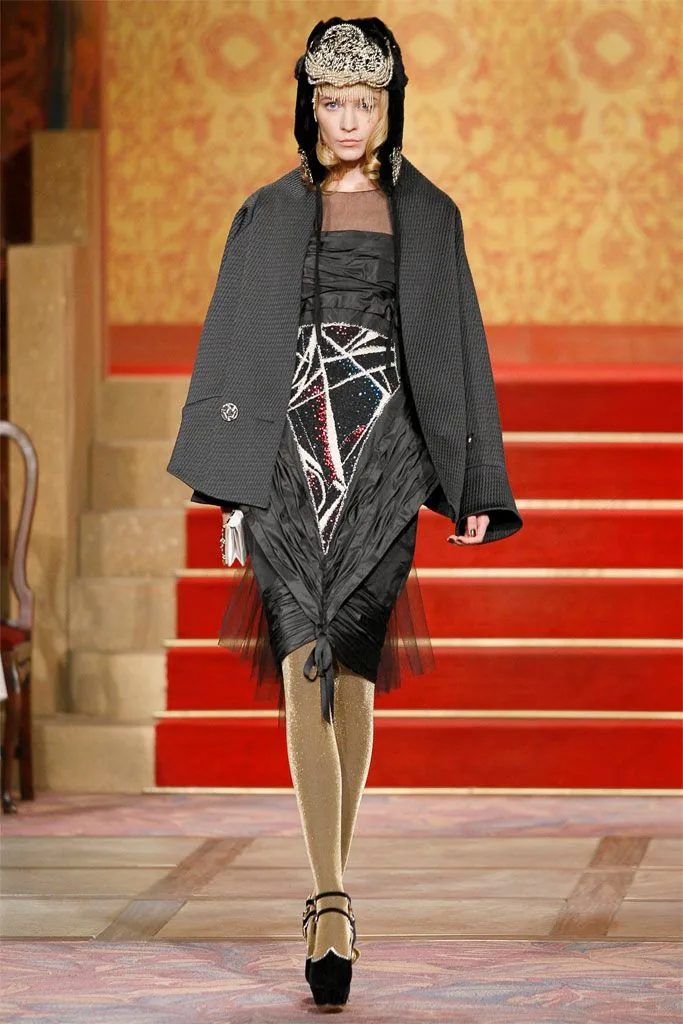
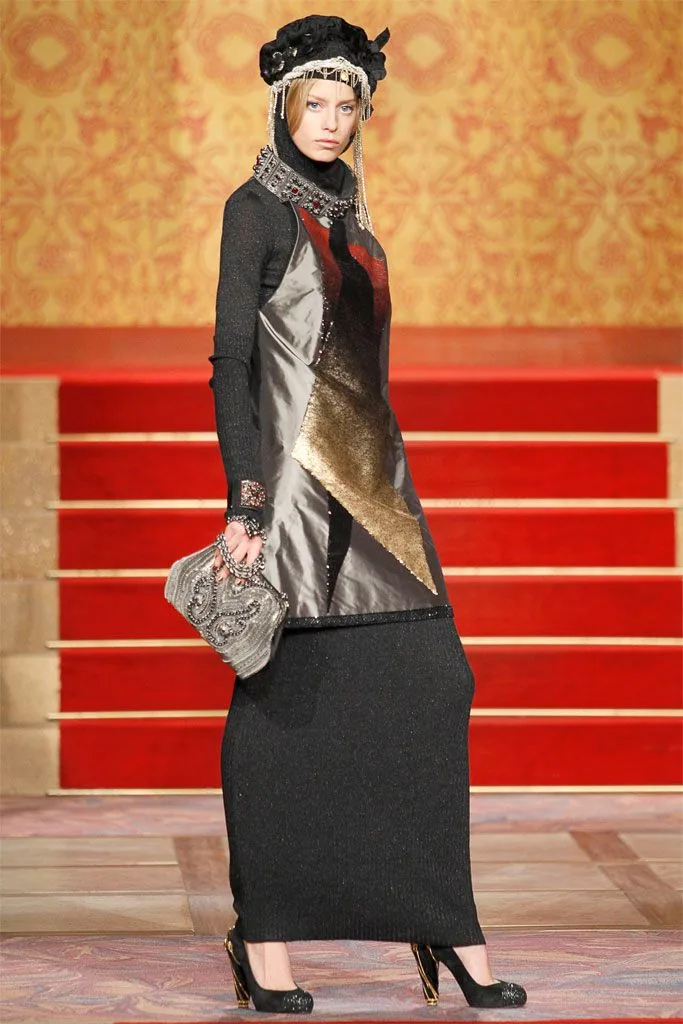
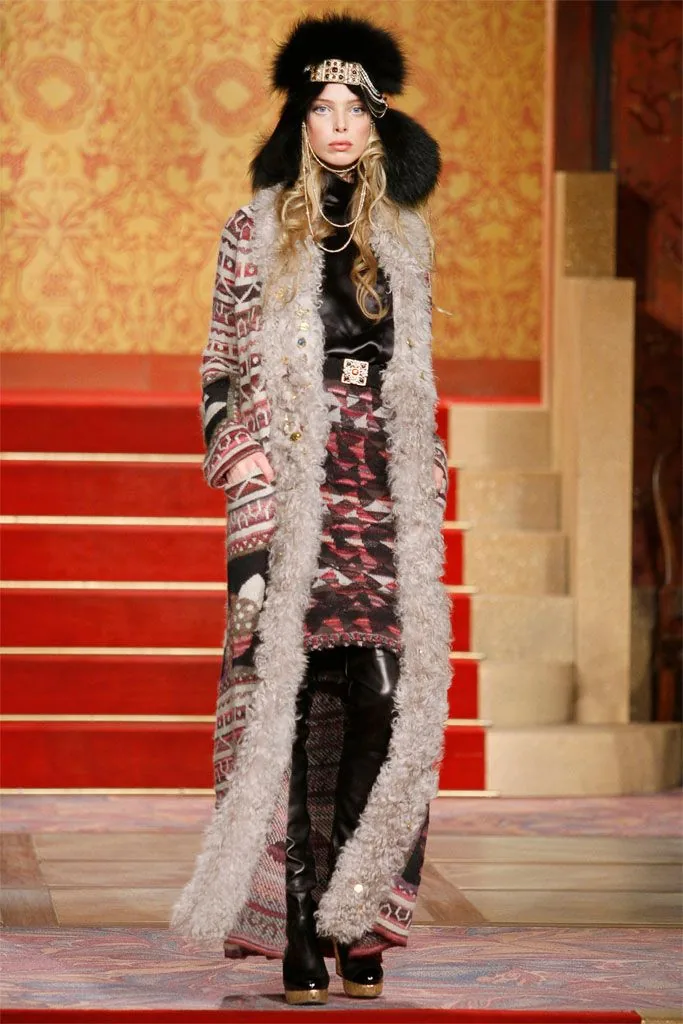
The avant-garde on the runway, Théâtre Le Ranelagh, December 2008
Popova had wanted art to become part of ordinary life. Nearly a century later, her revolutionary geometry was being embroidered by hand in Paris for women who could afford the exceptional.
In 1923, Popova exchanged the artist’s studio for the First State Textile Printing Factory in Moscow. Art was to be sold by the metre, and a woman need not enter a gallery to wear a Popova. A year later she was dead, at thirty-five.
History had an extraordinary sense of humour at Popova’s expense. In November 2007, her 1915 Cubo-Futurist collage Still Life with Tray sold at Sotheby’s in London for £1,700,500, setting a record for the artist. Popova had intended to abolish the distinction between art and everyday life. Sotheby’s had rather effectively restored it.
There is a charming detail in that million-pound composition. Among the fragments of newspaper and the fractured geometry of the avant-garde sits a black lacquered tray painted with golden leaves and folk flowers, the sort still made in the village of Zhostovo outside Moscow. The old Russia had survived the artistic revolution quite comfortably, on a tea tray. Lagerfeld was in excellent company.
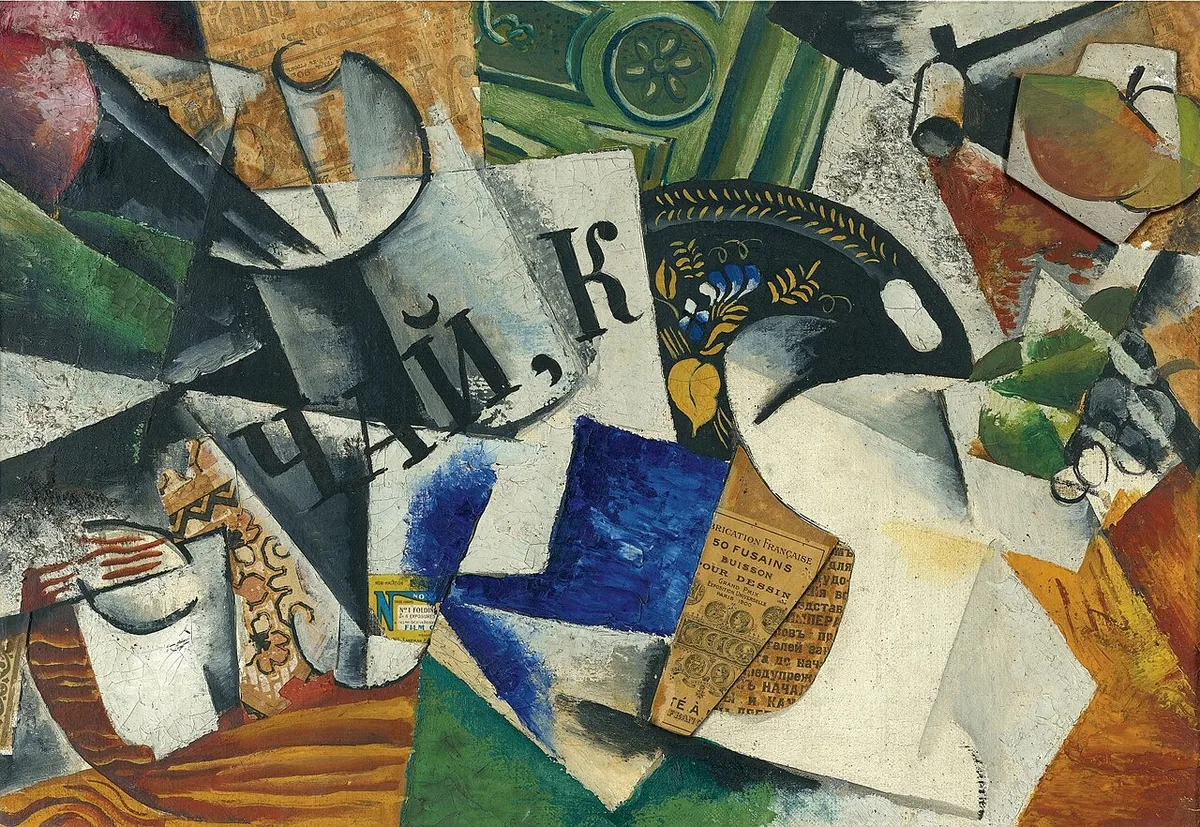
Sotheby’s · London · November 2007
Liubov Popova, Still Life with Tray, 1915
Sold · a record for the artist
1923Her cotton prints for a state factory, sold by the metre2007Her collage of 40 × 58 cm, sold by the hammer
What the two Russias shared was a fascination with the power of images. The Romanovs had expressed it through the opulence of the court; the avant-garde through the conviction of abstraction. Both understood that clothes, architecture and objects could change the way people saw the world.
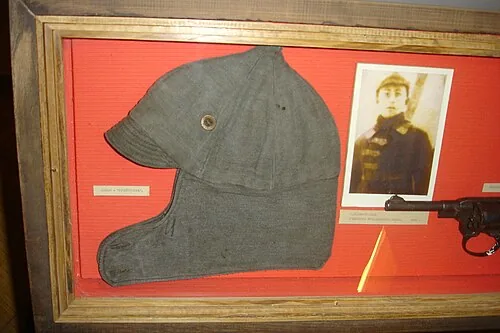
Even the budenovka, the pointed cloth helmet adopted by the Red Army in 1919, appeared alongside the pearl-covered kokoshniks of Paris-Moscou. After decades of historical antagonism, the Revolution and the Russian court had finally agreed to share a milliner.
ARTISAN
This was the art of the Revolution, embroidered by hand.
Yet the most personal Russian reference in Paris-Moscou came neither from the archives of Chanel nor from the walls of a Parisian museum.
Its origins lay in Hamburg, in the wardrobe of Lagerfeld’s father.
VI
Lagerfeld’s Childhood: A Secret Lined with Sable
“I have heard so much about Russia, so why shouldn’t I take Russia?”
Karl Lagerfeld to The Independent, December 2008
It would be tempting to assume that his interest in the country began with Gabrielle Chanel. In fact, it began long before he knew much about her.
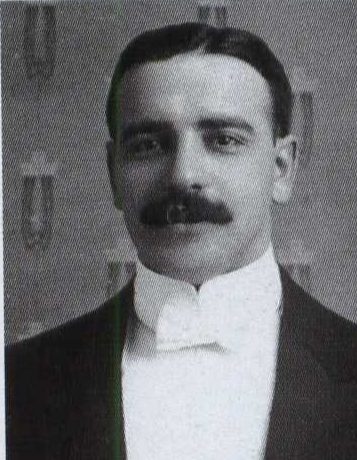
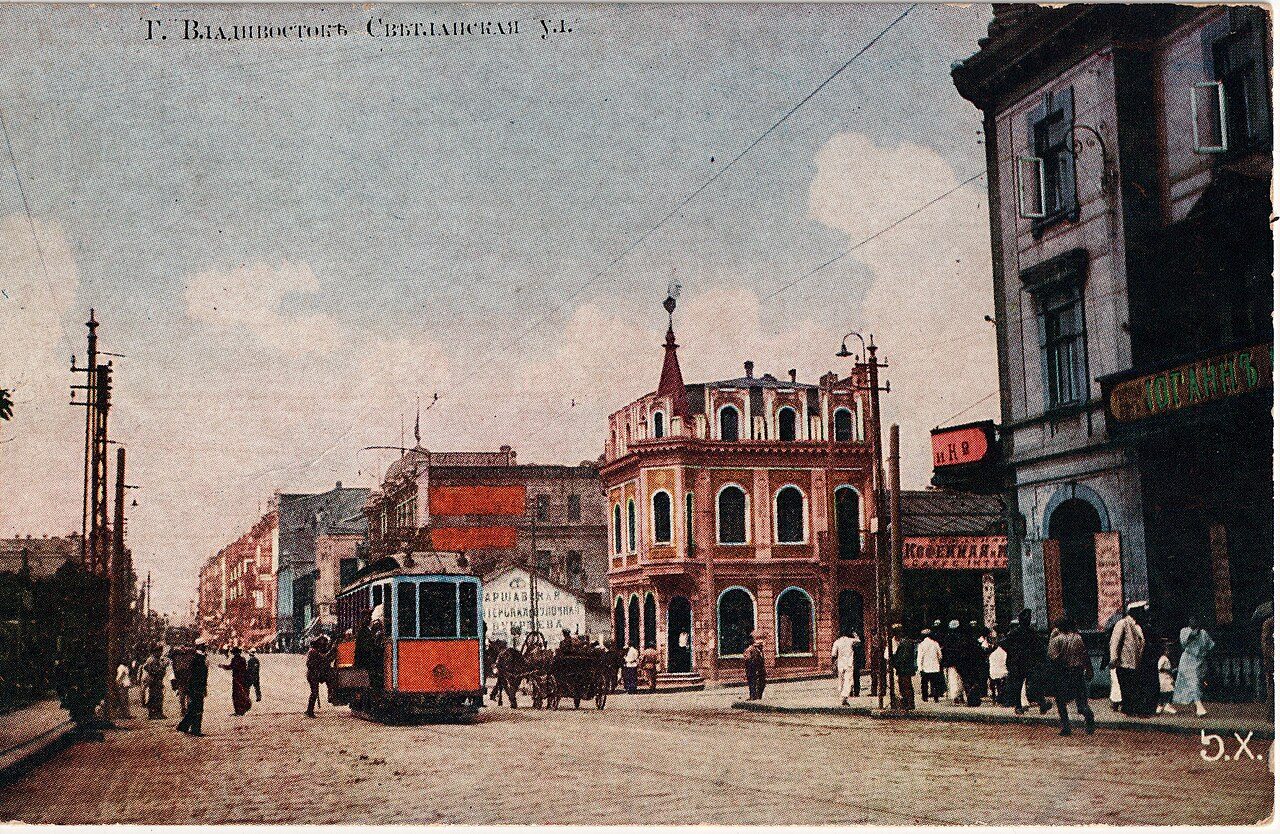
Otto Lagerfeld had lived in Vladivostok, the Russian port at the far end of the Trans-Siberian Railway, before the First World War. Among the things he brought home was a coat lined with sable.
In an interview with Vogue Russia in 1998, his son recalled its particular attraction: “I loved to try it on in secret.”
Vladivostok must have seemed impossibly distant to a little boy in Germany, yet here was a piece of that remote world that he could touch, wear and temporarily make his own. His first experience of Russia was not geographical but sensual.
His taste for fur never left him. In the same interview, Lagerfeld revealed that he slept beneath sable in winter and covered himself with ermine in summer. Apparently, there was such a thing as a summer fur.
Read the interview: The Luxury of Not Being Seen — Karl Lagerfeld’s Vogue Russia interview, 1998 →
There was an odd symmetry in the way the two great personalities of Chanel had encountered Russia. Gabrielle discovered it through people who had left the country; Lagerfeld through something his father had brought back. Neither had needed to see Russia to develop a taste for it.
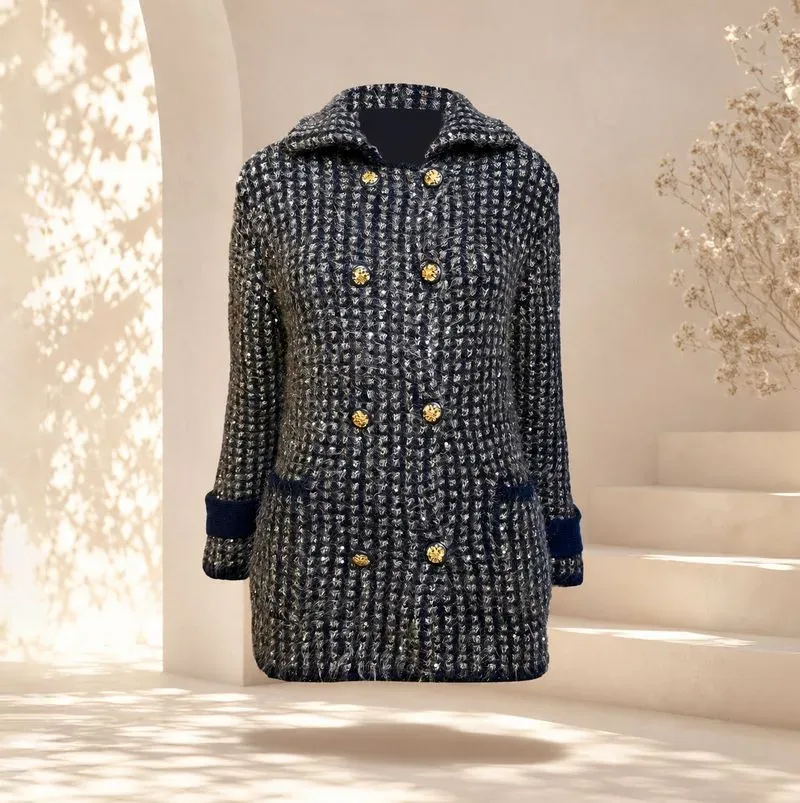
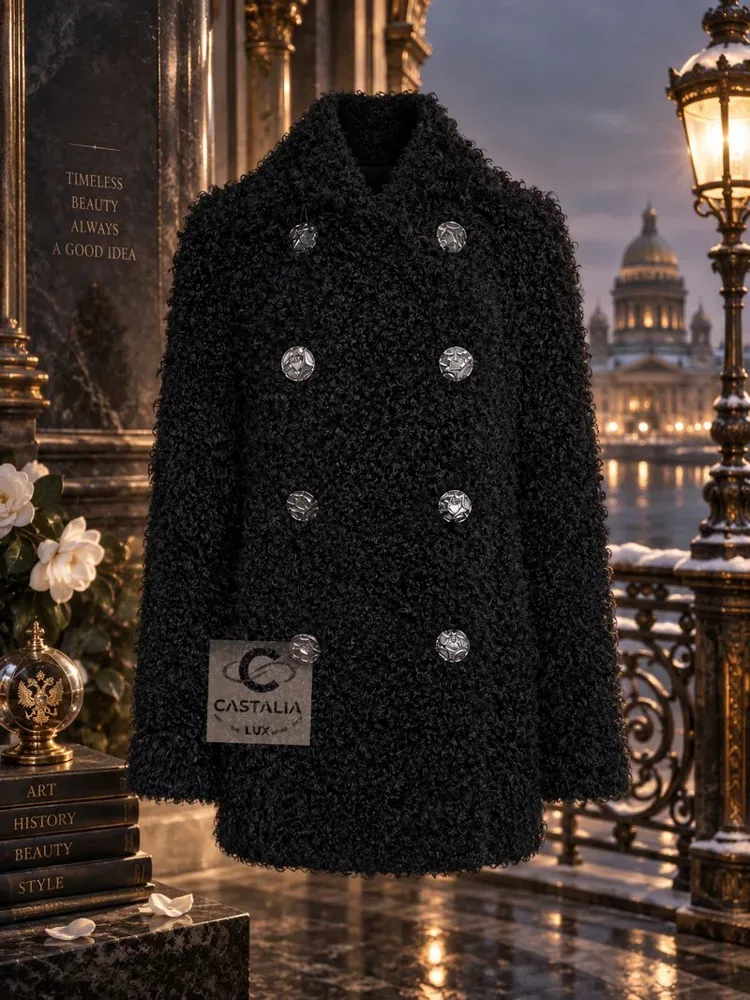
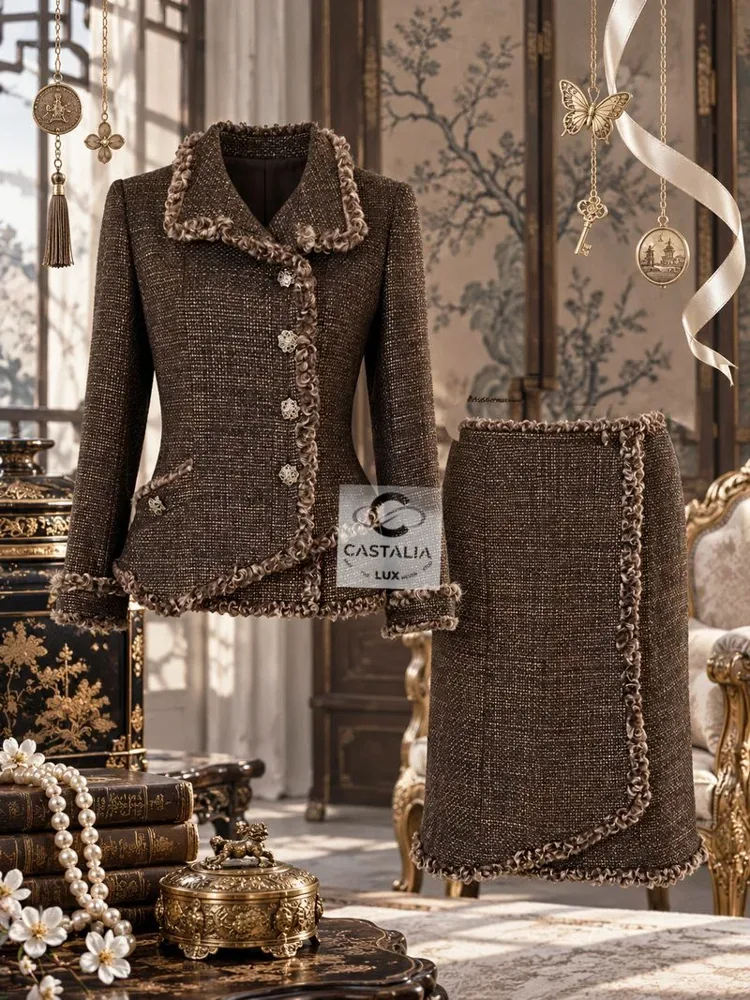
Russia means winter, and Lagerfeld dressed for it: shearling, astrakhan, muffs, Lesage tweed the colour of hot chocolate and the warm glow of Gripoix jewellery.
Nothing in it was costume. All of it could go to dinner.
For Lagerfeld, sable was more than an indication of wealth or an evocation of Russian winters. It belonged to his earliest experience of luxury, enjoyed in private, long before luxury became his profession. The little boy in his father’s coat could hardly have imagined what would eventually become of that secret.
Some childhood memories fade. Lagerfeld had his put into production.
Coda
Moscow, at Last
“As we know from Napoleon times, Moscow is not so far.”
Karl Lagerfeld to Vogue Russia, 2011
On 29 May 2009, he made his first visit to Russia, presenting Paris-Moscou at the Maly Theatre, where the Moscow-born Sasha Pivovarova opened the show.
The surprise was that a collection which had looked so Russian in Paris suddenly looked unmistakably French. Nearly a century after the Romanovs brought their taste to the rue Cambon, Russia was returning to its own capital as something exotic.
In the windows of a temporary Chanel boutique in Moscow, the 2.55 bags wore Lenin badges. Lenin had spent a good deal of his life opposing capitalism. Lagerfeld had found him a career in accessories.
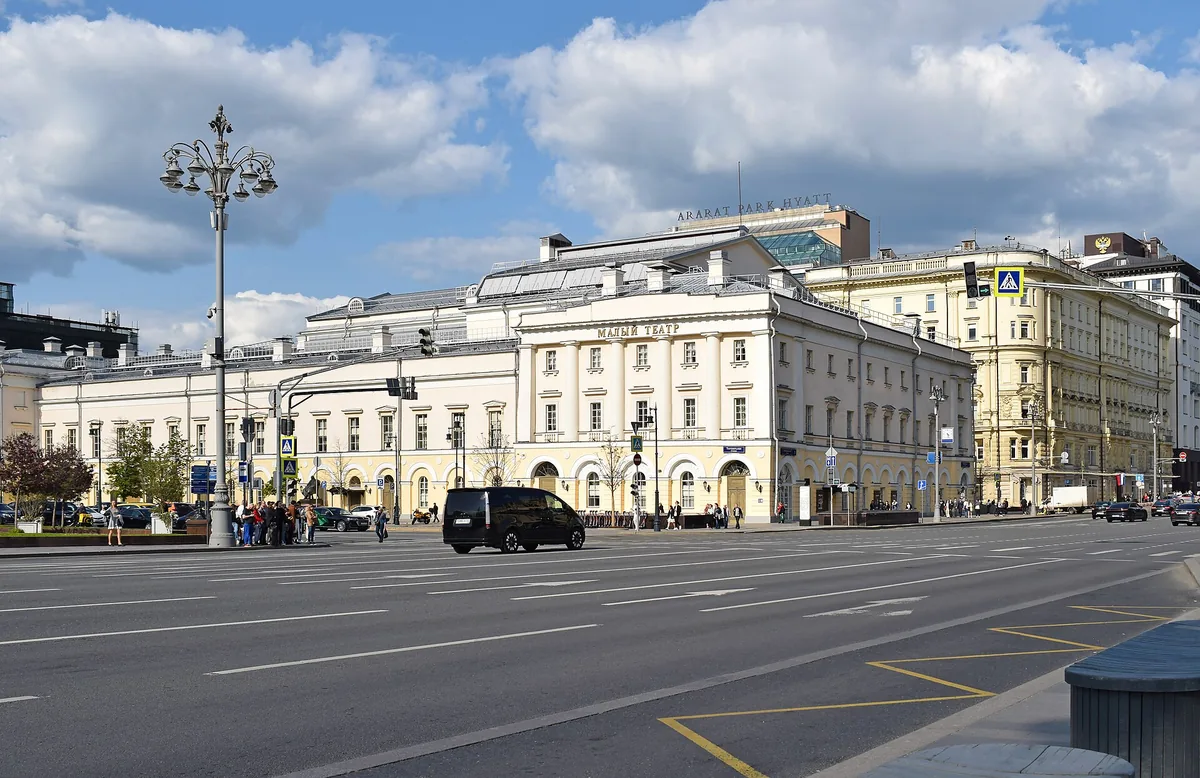
When Lagerfeld appeared on stage at the Maly Theatre, the front rows rose to applaud. The little boy who had once tried on his father’s sable coat in secret had come to Moscow at last, bringing with him a Russia that no Russian had ever known.
Russia had given Chanel a great deal. Lagerfeld returned it with interest.